
The new Linfield University Science Complex is paving the way for science education, students and the future
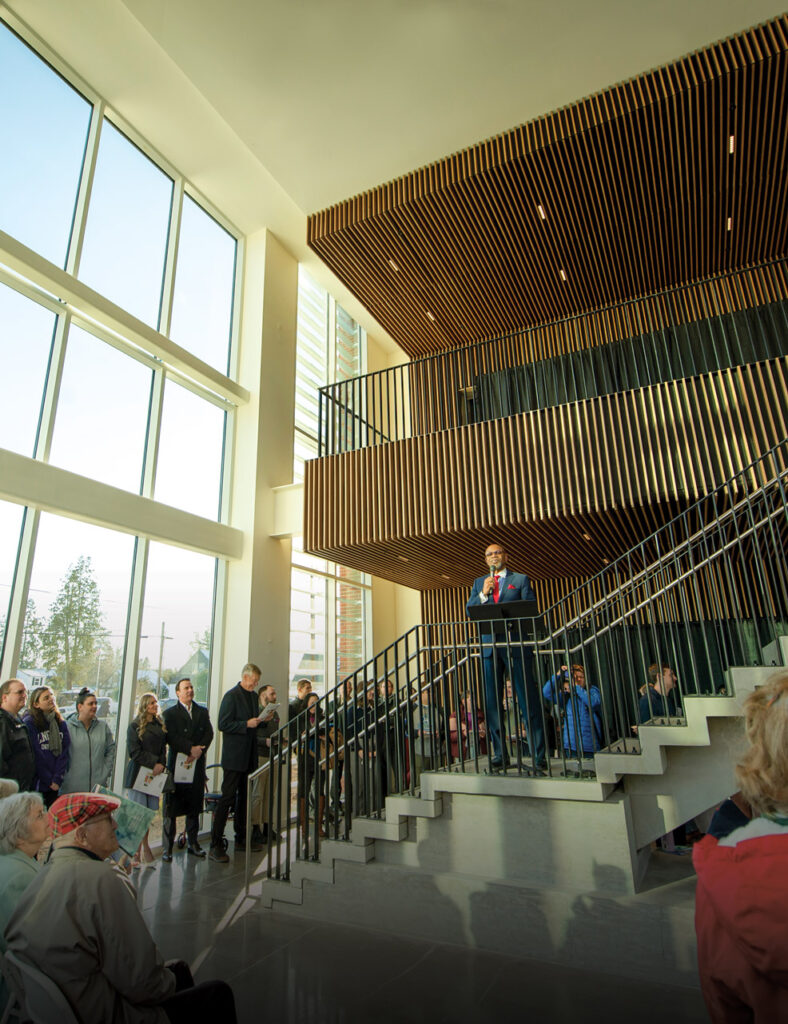
Linfield’s transformation from college to university has brought a number of changes over the past three years – a new academic structure, governance processes, a logo and a new campus in Portland, among other things. One of the most visible signs of Linfield’s new era, however, is the newly-opened Linfield University Science Complex.
In many ways, this complex epitomizes Linfield University.
It interweaves Linfield’s legacy for excellence in the sciences with a renewed emphasis on collaboration between students and faculty, as well as within disciplines.
It was created with students in mind. From new (and comfortable) study nooks to grouped learning spaces, consideration was placed on creating an area where students will gather and thrive.
Architects and university officials spent extra time and care, as well, to be fiscally and environmentally conservative in the approach to design.
It is truly a blending of modern and traditional – the design, the teaching and learning that will happen there and the discoveries that will be made.
An integrated science center for all
The hallmark of the complex, the W.M. Keck Science Center, adds 24,000 square feet to Linfield’s science facilities. It was integrated into and connected with a revitalized Graf Hall, which received an 11,200-square-foot addition, and Murdock Hall. More than 62% of the existing space in Murdock and Graf Halls was renovated during construction. The result is 84,400 square feet dedicated to science education, interdisciplinary research, and faculty and student collaboration.
“This building is the physical embodiment of Linfield’s dedication to science, to research and especially to students,” said Gennie VanBeek, interim dean of the College of Arts and Sciences. “The opportunities undergraduate students have at Linfield to do real-world scientific research is truly remarkable. The W.M. Keck Science Center and the entire science complex opens doors to even more life-changing opportunities.”
The laboratories and classrooms boast state-of-the-art technology and impressive features, specialized for the different learning spaces. Biology, chemistry and physics labs will see an increase in more than 100 seats available for students. But perhaps most impressive is what these new and increased spaces mean for students – and not just those majoring in the sciences.
“By increasing the amount of teaching and lab space available, our science departments are able to offer introductory classes to more students. This gives more flexibility for students in scheduling and taking their general education classes,” VanBeek said.
Supporting collaboration
A key to making the most of the space was an intentional design focused on collaboration.
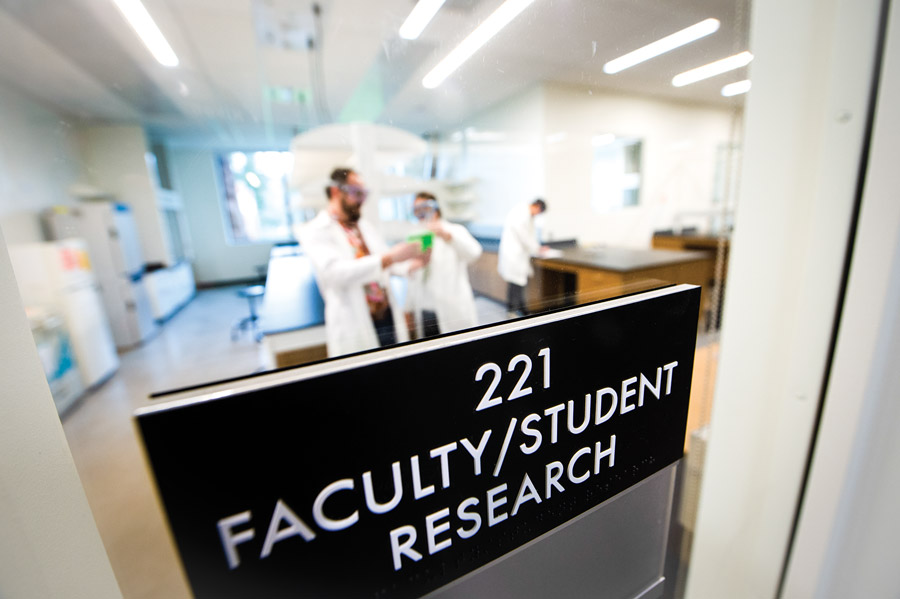
“The focus was on reinforcing integration between faculty in physics, chemistry and biology and the students they serve. To achieve a higher level of collaboration, all faculty offices are grouped around shared, glass-enclosed laboratory areas,” said Lisa Petterson, principal architect at SRG Partnership. “One important thing we did was to keep the space between the shared research labs and the offices larger to provide space for students to interact, engage or have chance meetings with faculty.”
But not all collaborative spaces in the building are formal offices or labs.
Sprinkled throughout the modern buildings are a variety of comfortable study spaces for students. In fact, the overall project increased the amount of study space by more than 200%. More than two dozen seating areas, booths, lounge areas and tables with monitors for shared work are scattered throughout the complex.
Honoring the past
While approximately 42% of the science complex consists of newly built spaces, the architects carefully planned the design to utilize much of the existing structures. The general contractor, Walsh Construction, worked with the design team to incorporate original architectural elements – including wood beams in Graf Hall – into the final space. The new additions were designed to connect so seamlessly to the current structure that it looks and feels like a single building.
Thanks to the generosity of donors, several spaces in the complex also pay homage to Linfield’s scientific past. Former faculty members Lynwood Swanson and Drannan Hamby ’55 are among those whose names alumni and corporate donors wanted to honor in the complex. Plaques bearing their names, as well as names of other science alumni and donors, are installed throughout the complex.
The integration of past-to-future doesn’t stop there.
A special physical marker commemorating Mac Hall will be added to the Linfield Avenue Garden. Mac Hall stood on campus from 1937 to 2021, when it was demolished to make room for the new construction. Bricks salvaged from Mac Hall will be used in the memorial.
Commitment to the environment
Deciding to renovate rather than demolish Graf and Murdock Halls was more than just a nod to Linfield’s scientific past. It was also a way to minimize the environmental footprint of the project overall.
“The American Institute of Architects note that renovation and reuse of projects typically save between 50 and 75% of the embodied carbon emissions compared to the construction of a new building,” Petterson said. “This is especially true if the foundations and structure are preserved, which is what we did with Graf and Murdock Halls.”
The complex is also highly energy efficient with the installation of a variable refrigerant flow cooling system, additional continuous insulation and argon-filled windows.
Those windows do more than provide scenic campus views. They were an intentional part of SRG’s design, utilizing daylight, along with energy-efficient lighting, to conserve energy.
“The building orientation, tall windows in lab spaces and LED dimmable lighting are anticipated to save 25-30% of the energy used in a conventional building,” Petterson said.
Built for the future
The new and updated spaces will be put to immediate and plentiful use: spring semester classes, meetings in the second-floor conference room, faculty and students continuing to collaborate on research projects, the return of the Oregon Nobel Laureate Symposium in the large event spaces and more.
Even better, the science complex is already prepared for the future. Several design elements were built into the project to allow the university to accommodate eventual growth and innovation.
The Keck Center, for instance, is photovoltaic-ready. The rooftop was structured to accept a modest-sized solar array to produce energy, Petterson said.
In addition, the basement of the Keck Center has the capacity for three or four additional laboratories or classrooms when the shelled space is fully built out.
In its totality, the Linfield University Science Complex is the biggest capital project in the school’s 165-year history, and one that will shape science education for generations of students.
“These new and updated facilities represent the best of Linfield,” President Miles K. Davis said. “They harken back to an impressive past, make an immediate impact on our present and open the doors to an even brighter future for our community. I invite anyone who hasn’t seen them to pay us a visit on campus and see for yourself how impressive and transformational this is for Linfield.”
A foundation of excellence
The names Keck and Murdock should be familiar to the Linfield community. They have long been tied to some of the most transformational moments in university history.

A closer look inside
The new and renovated spaces in the Linfield University Science Complex highlight a collaborative approach to science education.


