
Composer William Campbell creates haunting backdrops for internationally acclaimed documentaries
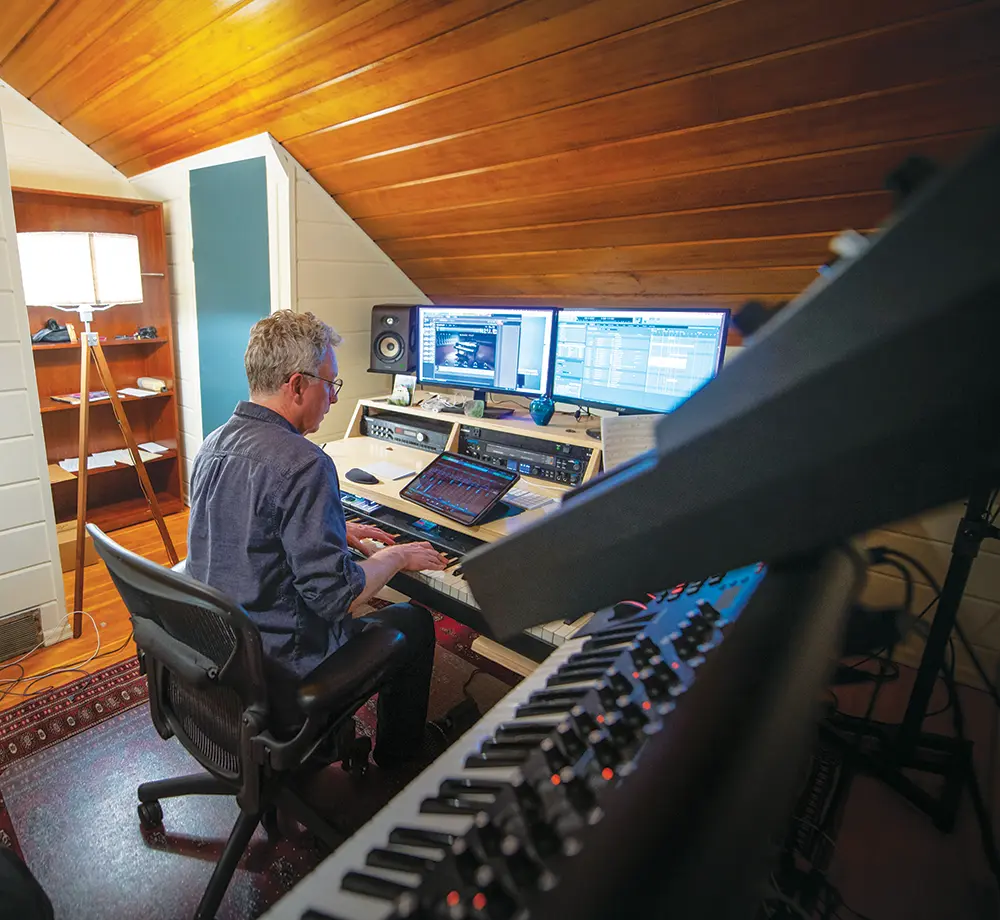
In late August, William Campbell found himself in a situation any creative would find simultaneously horrifying and envy-inducing.
Campbell – the chair, associate professor and director of composition studies in Linfield’s Department of Music – spent most of his waking hours composing the scores of not one but two prestigious documentaries, and the deadlines were only a few weeks apart.
“They were not supposed to overlap,” he said, laughing.
Luckily, he said, the two films called for very different compositions: “Chasing Roo,” about kangaroo hunting in Australia, was mostly electronic, while “Keep Quiet and Forgive,” about cycles of abuse in Amish communities, called for acoustic instruments. Both were “dark, ambient, mostly environmental — and emotional, too.”
Campbell has scored eight movies. Two – “Lifeboat” and “Hunger Ward” – were Oscar nominees in 2018 and 2020, respectively. He also received an Emmy nomination for Best Original Score for the 2020 docudrama “Sons & Daughters of Thunder.”
He has a niche — “documentaries with a social-justice lens.” His range of work has addressed starvation in Yemen, Libyan refugees who flee across the Mediterranean on crowded rafts and a surgeon operating on victims of the Syrian civil war.
Some call for haunting, repetitive piano. Others, mournful string arrangements. His process varies.
“Sometimes, I’m working out the ideas at the piano, and it’s the physical, auditory experience,” he said. “Sometimes, working it out in my inner ear, then on paper. But it’s the emotions … always the emotions.”
And, he said, it involves something powerful and intangible beyond himself.
“I feel like I’m a partner in process with whatever energy is there,” he said. “When I’ve lost myself in the composing, I’m totally unaware of time or anybody. Even myself, really. It’s a very wonderful out-of-body — but still in the body — experience.”
Now he is working to bring Linfield students to that same place.
“The student talent is higher than any group I’ve had the privilege of working with,” he said, laughing. “Maybe it’s something in the water?”
Through the Lacroute Composer Readings and Chamber Music Mentorship Program at Linfield, students work directly with professional musicians to perfect, and ultimately perform, their original compositions. Acclaimed pianist María García is mentoring students throughout the fall semester.
Come this spring, the student composers might follow in Campbell’s footsteps.
“Next semester, Dr. Campbell is trying to get some short films made for us composers to write scores for, which is something I’ve never heard about at any other school,” said Aaron Smith ’27, a composition major from Everett, Washington.
Offering students these real-world opportunities, Campbell said, allows students to experience a full creative process and build confidence in their skills.
“Our job is just to create,” he said. “It’s rare that someone sits down and improvises a piece of music and it’s done. It’s really in the revision process where the finished piece of music comes into its own. It requires a lot of work, and you have to maintain a sense of confidence in your own ability while also maintaining a sense of humility about the process.”
Read a Q&A with documentarian Skye Fitzgerald


