
Katelyn Greenawalt ’23 journeys from McMinnville to the sidelines of Major League Soccer
On a cold January morning in 2023, Katelyn Greenawalt ’23 pulled into one of the 4,500 parking spots at Toyota Stadium in Frisco, Texas, for the first time.
Life had come at her fast. Only eight months before, in May 2022, she graduated from DeSales University with a Bachelor of Science in sport management. That August, she moved from Center Valley, Pennsylvania, to Oregon to begin her Master of Science in sports science and analytics at Linfield. Only a few months later, on December 23, she was contacted by Major League Soccer’s FC Dallas.
“On Christmas Eve-eve, they called and said, ‘If you want this internship, it’ll be a yearlong internship instead of a summer one, and it starts January 5,’” she recalled. “I’m at home in Pennsylvania. All of my stuff is in Oregon at Linfield. And I was like, ‘Yep, no problem. I’ll be there.’”
While Greenawalt chose Linfield for the in-person learning experience, both she and associate professor Cisco Reyes, knew saying “no” wasn’t an option.
“It was definitely a ‘You need to go — you applied, they want you there, this could lead into bigger and better things’ situation,’” recalled Reyes, who coordinates the graduate program.
Greenawalt finished her master’s degree online, and the gambit paid off. In less than two years, Greenawalt steadily moved up the ranks — from intern to full-time employee and now, the team’s sports scientist.
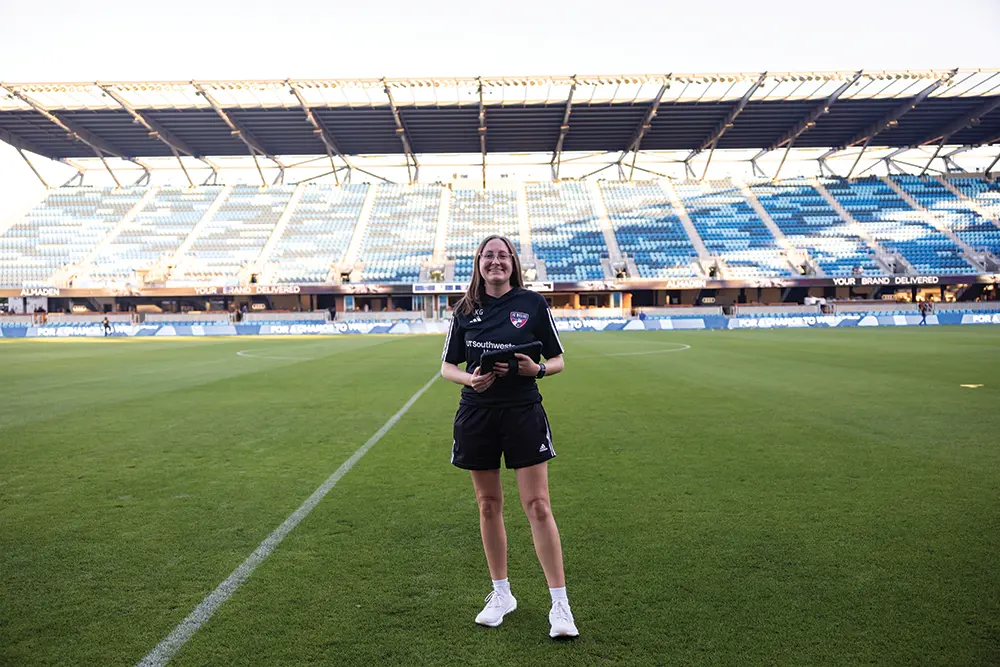
“There’s a lot that she does for us, and it is all very important to our team’s success,” said Ardavan Vahidtari, performance coach for FC Dallas. “For example, when we are looking at an injured player’s medical progress, we need to be able to identify every positive and negative trend. With the live data tracking, we can decide if things are progressing naturally or if there might be an underlining muscular issue that hasn’t been corrected.”
On an average day, Greenawalt said, she’ll arrive at the stadium at 6:30 a.m. to make sure her hyper-precise GPS units are charged. By 7:15 a.m., she’s on the pitch setting up equipment, then in a meeting to discuss individual and team goals for the day. Around 9 a.m., the players begin training.
As the players run through warm-ups, passing drills and keep-away drills called “rondos,” Greenawalt’s GPS units capture nearly 200 datasets on each player. While results stream to her iPad in real time, Greenawalt observes.
“I’m not the coach, and it’s not my job to see if they’re doing skills correctly,” she said. “I’m watching them and saying, ‘OK, I know from the data this guy has a hamstring issue; let’s see how he receives the ball.’”
After practice, the biggest part of her work begins. She curates the massive spreadsheets of data that show everything from intensity to max deacceleration speed. Out of the data, she finds the crucial points that can maximize the players’ advantage performance — or warn of an undetected injury.
“Part of being a sports scientist is that you’re a jack of all trades,” she said. “You have the whole circle — the data analytics, the coaching, the psychology, the strength, and conditioning, the performance side, the medical side. You have to know a little of all of it.”
Even a few years in, Greenawalt is amazed at how fast everything transpired.
“It didn’t really hit me until our first friendly [exhibition match] that I get to sit on the sidelines of a professional team. This was my dream since I was 17,” she said. “Everything I’ve worked for is to get this job, and I still can’t believe I get to do it. It doesn’t feel real.”


