
 Controversy about free speech and contentious speakers on college campuses is increasingly making headlines nationwide. Linfield College is not immune to the trend.
A speaker invited by a student group last spring ignited a mini-firestorm. Heading into the 2017-18 school year, Linfield addressed the issue head-on by hosting a series of events highlighting civil ways to debate, discuss and disagree. It may be swimming against the cultural tide. Increasingly, college campuses are serving as battlegrounds for outside groups. A speaker’s appearance is supported by individuals promoting a potential view or issue. In some cases, their sole intent is to generate controversy and attention. And on the other side, protests over speakers are often supported by off-campus individuals, as well.
Take, for example, a speech by Charles Murray in March 2017 at Middlebury College in Vermont. The local college chapter of the American Enterprise Institute, a right-leaning national organization, had sponsored a speech. Murray is a controversial figure because of his 1994 book The Bell Curve, which, wrote Politico Magazine, “suggested that racial differences in intelligence could partly explain the socioeconomic gap between black and white Americans.”
Protests to shut down the speech were inflamed in part by the Green Mountain Anti-Fascist Action, an off-campus group, and forced Murray to deliver his talk via a video feed instead. As he and a Middlebury College professor later headed to a parking lot, protestors surrounded them. The incident received national attention, including an op-ed in The New York Times defending Murray’s right to speak.
Controversies aren’t limited to any particular part of the political spectrum, though. Catholic University in Washington, D.C., disinvited the Rev. James Martin, a Catholic priest in good standing, after a furor over his pro-LGBTQ views. At Liberty University in Virginia, a pastor was removed and banned from campus for his criticism of school president Jerry Falwell Jr., and Falwell’s support for President Donald Trump. And Trump supporters recently shouted down California Attorney General Xavier Becerra at Whittier College.
Linfield hosted three events during the fall semester that sought to present opposing viewpoints in a civil manner. First, the college hosted a “Conversation About Speech and Equality” as part of Constitution Day events in September. Moderated by Nick Buccola, professor of political science, it featured Cheryl Harris and Jonathan Rauch. Harris is an award-winning civil rights educator and author. Rauch writes for The Atlantic and is a Brookings Institution fellow. They covered a range of issues focused around the broader theme of how to approach the issue of hate speech, especially as it relates to First Amendment protections.
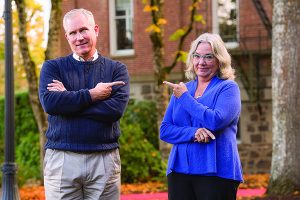
In October, two Linfield alumni, who both graduated in 1978 and now serve together on the Board of Trustees, discussed their wide differences on policy and politics, but also how they remain collegial and friendly. Phil Bond ’78 has been active on the Republican side of the aisle, including serving under President George W. Bush as an undersecretary of the U.S. Department of Commerce for Technology, and as chief of staff for Washington Congresswoman Jennifer Dunn. He continues to advocate for conservative causes. Michelle Giguere ’78 has been active in Democratic politics and is a founding partner of Summit Strategies, a lobbying and policy analysis firm in Washington, D.C. She also served as legislative director for former Oregon Congressman Les AuCoin. The discussion was moderated by President Thomas Hellie.
“Don’t doubt people’s motivation,” Bond told the Linfield community. “They all have the best intention in mind. I have never questioned Michelle’s motivation, even if I thought her policies behind that motivation were wrong. The former Speaker of the House, Tom Foley, a gentleman of the first degree, was often referred to as ‘cursed with seeing both sides,’ but that was his greatest strength.”
Giguere emphasized the importance of cooperation in getting work done in Congress, and the civility it requires.
“You won’t change someone’s mind by being rude,” she said. “You have to understand how they think and ask questions to get to a better understanding.”
She shared a story of two congressmen, a Democrat and a Republican, who hiked into the mountains together for three days, hearing diverse opinions from experts on the environment and forestry management along the way.
“They ended up collaborating on a very significant wilderness preservation bill that was enacted,” Giguere said. “This is the kind of interpersonal communication required to get things done.”
Finally, in November, Linfield hosted a discussion over religious liberty and discrimination. It featured Mark Hall, a politics professor at George Fox University, and Steven Green, a law professor and the director of the Center for Religion Law and Democracy at Willamette Law School.
With all the focus on the discord on campus, there remains hope for America’s college students. A study by professors from Ohio State University, North Carolina State and James Madison University is examining how the political attitudes and opinions of college students change once they step on campus. According to the study, after one year in college, many students have increased their favorable opinion of both liberals and conservatives.
The researchers suggest this is because of their interaction with fellow students.
“One central aim of higher education is to encourage contact, debate, discussion and exposure to persuasion from different kinds of people,” the researchers wrote in a summary of their study in The Conversation. “After a year of college, in other words, it might be more challenging for students to brand all liberals or conservatives as wrongheaded when they are studying, eating and learning alongside them.”
– Kevin Curry ’92


