

The idea of working overseas conjures thoughts of exotic locales and exciting adventures. For Joshua Johnson ’04 and Kelsey Lyle ’07, the joys of being an expat are simpler than that.
“I like walking down the street and taking in the sights, dodging traffic,” says Johnson.
“I love being around people who think differently than me,” Lyle adds. “The constant adjustments and misunderstandings keep me on my toes and engaged.”
A passion for serving others, combined with their liberal arts education and study abroad experience, has driven the couple’s careers. It led the pair from the Peace Corps in The Gambia, a West African country of 2 million, to serving in the U.S. Foreign Service at the American consulate in Chennai, India, with more than 10 million residents inside city limits alone.
Nearly 8,000 foreign service officers (FSO) serve in 270 embassies, consulates and diplomatic missions around the world. This is up from 6,588 in 2007. Even so, they make up a small percentage of the 75,000 people that work for the U.S. Department of State.
“My colleagues come from the military, from the press, from the private, public and academic sectors,” says Johnson. “Some things they have in common are an openness to new experiences, the ability to become comfortable being uncomfortable, an interest in language and culture, flexibility and patience.”
Both Johnson and Lyle graduated with majors in psychology, and each studied abroad while at Linfield. Johnson spent a semester studying in Austria, while Lyle took a January Term philosophy course in Spain. Both also took on leadership roles and became active in service projects.
“Linfield inspired us to want to serve,” Lyle says. “The professors and international friends I made at Linfield opened my eyes to ways of thinking and being that I was unfamiliar with.”
Johnson says a summer internship with the FBI sparked his initial interest in working for the government. Then while in the Peace Corps, he heard a presentation from the Deputy Chief of Mission at the U.S. Embassy in The Gambia.
“After meeting foreign service officers who worked in the field, I made it my goal to join their ranks,” Johnson says.
He credits the liberal arts approach to education at Linfield for providing a solid foundation for the Foreign Service exam, the first step in pursuing a career in the field.
“Studying liberal arts gave me a wide range of knowledge, which was a great help on the Foreign Service exam,” he says.
In the Peace Corps, Lyle was a health volunteer and Johnson volunteered in agroforestry. That led to Johnson getting work at the U.S. State Department as a civil servant before taking the Foreign Service exam.
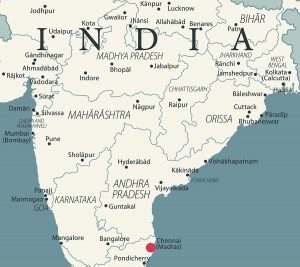
Today, they both work for the consulate in Chennai, in southeastern India. Johnson is a foreign service officer and Lyle works as the community liaison officer. In his role, Johnson assists U.S. citizens and non-citizens in various activities dealing with the U.S. government. For example, his office issues passports, helps register the births of U.S. citizens overseas, and assists Americans who have been hospitalized or arrested. It also processes visa requests from foreigners wishing to come to the United States, including student and immigrant visas. In her role, Lyle assists new families as they adjust to living and working in India and helps plan activities.
Johnson has these three pieces of advice for those interested in foreign service. First, make sure it is something you truly want to do. “It’s not a constant vacation. Working overseas can be stressful at times and you are a long way from friends and family.”
Second, look at all your options for government service overseas. The Foreign Service is just one of a number of opportunities via the U.S. government, including USAID, the Department of Agriculture’s Foreign Agricultural Service and the Department of Commerce’s Foreign Commercial Service.
Finally, keep trying. “Never, never, never give up. I didn’t pass the first two times I went to the oral assessments, but in no sense did I fail,” Johnson says. “The hiring process is incredibly competitive and after each attempt I continued to learn and grow and gain additional experience, both paid and voluntary.”
Their next assignment in the Foreign Service is in Mexico City in 2019. They hope to move to a new assignment every two to three years, with a possible stint in Washington, D.C. mixed in. They enjoy the cultural experiences their 2-year-old daughter, Ingrid, receives by living overseas.
That doesn’t mean they’ve forgotten their time at Linfield.
“We hope to retire in the Pacific Northwest someday,” Lyle says.
– Kevin Curry ’92
5 steps to foreign service
Joshua Johnson ’04 outlines the path:
- Take the Foreign Service officer test: “I love trivia so this test was actually a lot of fun for me.”
- Submit personal narratives: “If you pass that test then you are invited to submit concise personal narratives about your leadership and cross-cultural experiences.”
- Attend the Foreign Service oral assessment: “The next stage is a full day of assessments measuring your ability to problem-solve, work with others, use good judgment, and written and oral communication. I was invited to orals three years in a row and passed on the third attempt. It is a tough but fair assessment.”
- Receive a job offer…maybe: “If you pass the orals then you
are placed on a register ordered by score and may receive a job offer.” - Get clearance and start: “You must receive top secret clearance and receive a positive final suitability review before joining what’s called an A-100 orientation class.”


