
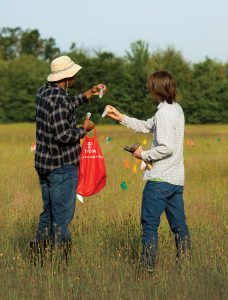
Clutching a mallet and metal pipe in his left hand, Liam Home ’20 hops down from a five-foot tall metal gate. He turns back to help his biology professor, Chad Tillberg, navigate the obstacle. Safely over the gate, they head into the waist-high grass in search of a series of small orange flags.
Only a year ago, Home was a recent high school graduate from Salinas, California preparing to head off for his first year at Linfield College. Today, he’s engaged in field biology research, examining how a narrow spectrum herbicide affects the interaction between ants and the endangered Fender’s Blue butterfly, a species endemic to Willamette Valley prairies.
Home is one of 40 Linfield College students who worked on research projects with Linfield faculty last summer. While the bulk of the students, 29 of them, worked in the natural sciences and math, several others worked with professors from other disciplines, including psychology, English, philosophy, mass communication political science. (See list below.)
Twice a week for a few months, Home, Tillberg and two other Linfield students, Jordan Clark ’18 and Michael Molgaard ’18, made the trek down to a series of fields near Fern Ridge Reservoir west of Eugene. The fields, which are under the oversight of various government agencies like the Army Corps of Engineers and non-profits like the Nature Conservancy, are home to some of the only remaining Fender’s blue butterfly populations on earth.
The Fender’s blue was thought to have gone extinct by the late 1930s but was rediscovered in 1989 in the Willamette Valley. butterfly relies on a specific plant, Kincaid’s lupine, for reproduction. It lays its eggs on the plant and then the caterpillars use it for food prior to becoming an adult butterfly. The conversion of prairie habitats in the Willamette Valley to agriculture is largely responsible for the decline of Kincaid’s lupine, and recent introductions of invasive species, such as tall oat grass, have made the situation worse.
“If you could put all of the remaining fragments where Fender’s Blue still occurs together in one place, it would only be about 400 acres; that’s just twice the size of the Linfield campus,” Tillberg says.
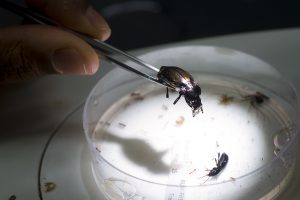 A graduate research team from Washington State University is using the same fields to focus on the plant community and the butterfly itself. Tillberg’s team is interested in the relationship between the caterpillars, ants and beetles in the plots due to any changes created by an herbicide targeting the invasive grass species.
Molgaard explains one of the reasons they are interested in the caterpillars, ants and beetles. “The ants will help protect the butterfly from predators like the beetles,” he says, “because the caterpillar has a little gland that produces sugar for the ant to eat.”
The team sets and picks up dozens of pitfall traps. The traps look like large, plastic test tubes and contain what Clark calls ‘kill juice’ – water, dish detergent and salt. Tillberg and his team use metal pipes and mallets to create holes in the ground wide enough to hold the traps snuggly and deep enough so the top is flush with the ground.
Gravity does the rest, capturing whatever creatures fall in. The insects they are studying, the ants and beetles, are numerous.
“They’re having their normal life, just walking around throughout the plots and as soon as they come over the trap they just fall right in,” Clark explains.
The team sets the traps once a week and then returns 48 hours later to collect them. Each trap is marked with a label indicating the field location and a specific 20 x 20 meter plot within the field. Some plots have been treated with the targeted herbicide while others are left to grow naturally.
Students get involved in summer research for various reasons. A faculty member who sees the skills and curiosity needed to thrive in a research environment recruits some. Clark and Molgaard, for example, are both on the pre-med track at Linfield and were persuaded by Tillberg to participate as a way to round out their undergraduate experience and improve their résumés for medical school.
A fellow Linfield student who had worked on the project before and thought he would be a good fit suggested the summer research opportunity to Home. “What I want to go into is pesticides or GMOs, biochemistry, and so this herbicide we are using is fairly interesting,” Home says.
Back in the lab, the students methodically work their way through the traps they’ve collected. They dump the contents into small dishes and examine through microscopes what they’ve captured. Ants are sorted into one section, beetles into another and everything else, like spiders, into a third. Each different creature is counted, placed in a small tube and labeled.
Home holds up a small label. “I wrote ‘Formica 14’ because there are 14 ants in there and they are of the genus Formica,” he says. “On the front here, I wrote the date that the tube is from and this is from Plot 16, Trap E.” He places the tiny slip of paper in the tube with the ants.
After entering the data into a master spreadsheet, he places the tubes in a holder. Once a collection date is complete, they transfer them to a box that is labeled with the date, the insect type as well as the plots and traps contained the box. A freezer is the final resting place for the collected insects, which allows Tillberg to double-check his students work and examine the collections himself if needed.
“It’s really been a privilege. I’ve been learning a lot of skills that will put me one step ahead in this coming year and make my lab work considerably easier to keep up with,” Home says. “It’s been a great deal of fun, a good learning experience, and a great way to get experience living on your own and taking care of yourself.”
– Kevin Curry ’90
2017 Student-Faculty Collaborative Summer Research
Conservation Effects on Endagered Species
Professor Chad Tillberg, Jordan Clark ‘18, Michael Molgaard ‘18, Liam Home ’20
GABA Receptors in Zebrafish
Professor Cecilia Toro, Austin Ramsay ’18, Shannon Apgar ’20, Jackson O’Keefe ’18
Wine Grape Microbiomes
Professor Jeremy Weisz, Shea Gischer ’19, Alexandra Morse ’19
Sea Sponge Research in Florida Keys
Professor Jeremy Weisz, Carmen Hoffbeck ’19, Clara Prentiss ’18
Mitochondrial Copper Proteins and Reactive Oxygen Species
Professor Megan Bestwick, Matt Walser ’18, Kelly Shultz, Kelsey Bruce ’19, Shae Reece ’18, Sarah Rempelos ’18
Reading Chaucer
Professor Jamie Friedman, Madeleine Glenn ’20
High Desert Journal Assistant Editorship
Professor Joe Wilkins, Tor Strand ’18
Urbanization on Forest Mycorrhizae, Worms, and Soil Respiration
Professor Nancy Broshot, William McCuen ’20, Delaney Riggins ’19
Relationship Between Stress and Physical Activity
Professor Sarah Coste, Courtney Stroh ’18
Physical Activity in People with Visual Impairment
Professor Janet Peterson, Sarah Bell ’19
Big Data and the Stock Market
Professor Xiaoyue Luo, William Shannon ’19, Jennifer Moranchel ’18
Care for Transgender Clients
Professor Paul Smith, Andrew Wolfe ’17
Pedagogy for Civic Literacies
Professor Kaarina Beam, Joshua Harper ’18
Graphene Biosensors
Professor Michael Crosser, Geoffrey Rath ’18, Agatha Ulibarri ’18
Brushless Micro Generator for Wearable Devices
Professor Tianbao Xie, John Adam ’18, Nickolas Villalobos ’19 James Baldwin, William F. Buckley Jr., and the
American Dream – Professor Nick Buccola, Madeline Colson ’19, Chase Stowell ’18
The League of Nations, the Iraq War, and the Future of Multilateralism – Professor Pat Cottrell, Benjamin
Bartu ’18, Aspen Brooks ’19
Sexually Objectifying Media and the Objectifying Gaze – Professor Tanya Tompkins, Hailey Albin ’18
Narrating Celiac Disease
Professor Hillary Crane, Elizabeth Stoeger ’18, Mikaela Letsinger ’20
Arts, Music, and Community After the 2013 Boulder County Floods
Professor Rob Gardner, John Christensen ’18, Alana Thomas-Garcia ’19
“Waiting for Peace” Documentary
Professor Michael Huntsberger, Grey Patterson ’18, Matthew Totaro ’18
Women’s Representation in Post-Soviet States
Professor Dawn Nowacki, Molly McTaggart ‘17
MicroRNA-mediated gene
Professor Catherine Reinke, Katherine Andersen ‘19, Sean Bowden ‘18, Laura Engle ‘17, Hayden Rock ‘18, Cami Soriano ‘18
Complexity and Fly Swarms
Professor Joelle Murray, Austin Bebee ‘18, Troy Taylor ‘18


