
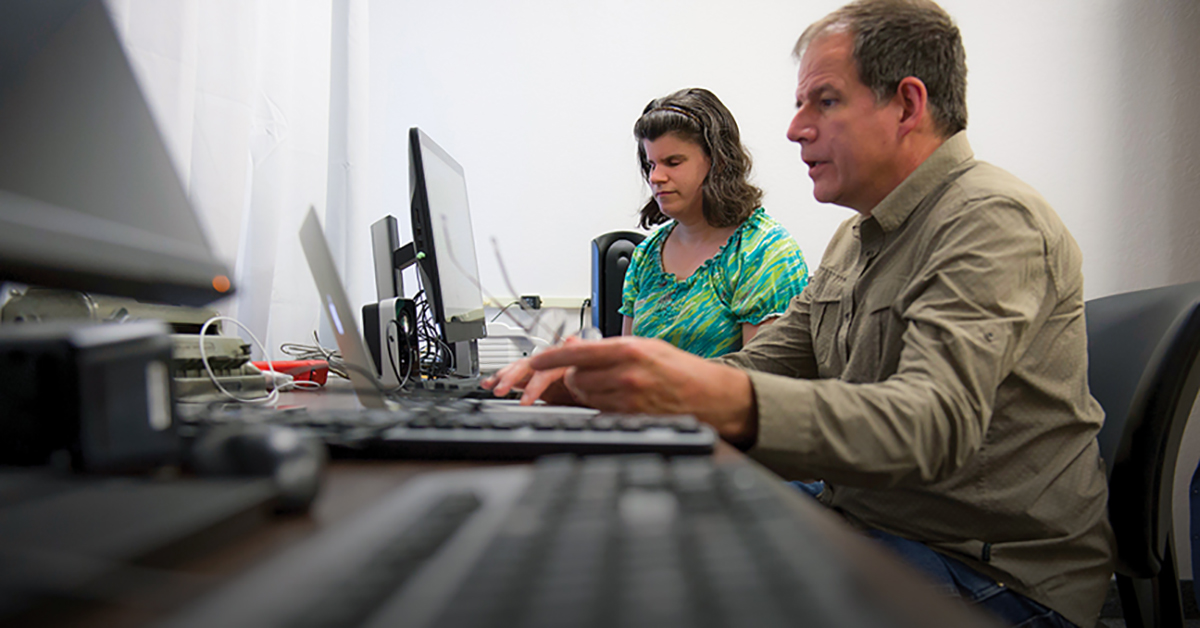
Kat Denicola is scanning the web. She types in the Linfield College web address, and listens as her computer rapidly recites the content from the top of the page: “Link-skip-content-list-with-7-items-prospective-students-link-current-students-link-resources-link-heading-heading…” The dictation flies by at 125 words a minute.
“Do you want me to slow it down?” Kat asks. I did, but told her no. This was an opportunity for me to learn what Linfield’s website “looks like” to someone who can’t see.
As the person in charge of Linfield’s website, I have to remember that our site will be experienced on everything from 27-inch desktop monitors to iPhone screens. I have to remind content editors that a prospective student probably doesn’t know what “colloquium” or “paracurricular activities” are. I also need to make sure our site meets federally–mandated sets of accessibility regulations. In essence, those rules say Linfield can’t discriminate on the basis of disability. This includes our website. All the information there should be available to any visitor regardless of their capacity to see, hear or use a keyboard or mouse.
There are thousands of changing web pages and files on Linfield’s site that fall under those rules. I use automated tools to give me lists of accessibility errors in those resources. Those tools are immensely helpful, but they aren’t human, and they say little about the experience of using our website if you have a disability. A car might pass an automated usability test if the software detects that it has an engine, windshield, seats, wheels and seat belts; but it still might be undrivable. Trying to close this experience gap led me to the Oregon Commission for the Blind – and Kat.
Kat, who’s the assistive technology instructor for the Commission’s Salem office, is totally blind. She was thrilled someone would try to improve a website for people with vision limitations, and graciously gave up several hours to share her experience navigating the Linfield site.
A screen reader is software that lets her computer dictate the content of a web page, and lets her use key commands to move around that page. It also alphabetically sorts the links so the whole page doesn’t have to be read back to her to find one link. Experienced users accelerate the dictation to navigate more quickly. Kat was a pro and moved through a page as fast as I could read it.
After an hour, I was getting used to the rapid dictation. Kat explained that web page headings are among the most important navigation aids for her. That was the “heading-heading” I heard when she first started. By hitting the “H” key, she could jump from one heading to the next to get a summary of that page section before moving on. Over the course of an afternoon, Kat identified where she found content confusing. I explained what was happening on the page and if I was able, fixed the issue.
The time we spent together was so informative that we scheduled a group session with assistive technology instructors from across the state. I went to the Commission’s Portland office and worked with their team. Kat and several other instructors conferenced in and we navigated through an assortment of Linfield’s web pages. Filling out one of our inquiry forms, the instructor using the screen reader stumbled on a set of buttons. I changed
the source code, then we talked about what I did and how easy it was to fix. That moment really was the crux of why I was seeking their help.
Like most of the Linfield community, I can see, hear and move without limitation. I will always frame my understanding of the world from that perspective. That’s why the Americans with Disabilites Act and the Rehabilitation Act exist. They give us guidelines to make accommodation for those whose life experience is different from our own. Working with Kat puts the humanity in those laws.
In Oregon, there are more than 100,000 people who identify as “vision impaired.” When we design to meet their needs, we all benefit. Web content, for example, sometimes tries too hard to be cutting edge or clever at the expense of basic usability. We’re all grateful when a site works well.
More importantly, when we forget about people with disabilities, or define them as such a small percentage that it’s not worth making accommodation for them, we are doing more than underestimating the number of people we are excluding; we are marginalizing a group. We are being cruel.
That’s not Linfield. We must keep working to remain true to our mission.
– Jonathan Pierce


