
My eyes are closed. Everyone thinks I’m sleeping. Good. That’s how I want it. I know, and Taylor knows, that I’m working – waiting for the moment when she needs me. A deep inhale, followed by a quick exhale. I recognize that one – she’s stressed. Time to go to work. I sit up and rest my paw on her leg to let her know I’m here, and that she’s going to be okay.
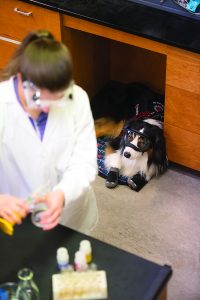
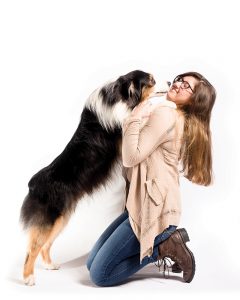
Taylor Gwinn ’20 refers to Vicar (Vic), her service dog, as her child. She wants to be a police officer someday and works for the McMinnville Police Department, which means arranging for someone to take care of Vic a few times a week in her absence.
“I feel bad (leaving him alone),” says Gwinn, a biology major who spends nearly every hour of every day with Vic by her side.
The presence of animals on college campuses is becoming increasingly common. Lyon College in Arkansas announced in January that it will open the state’s first pet-friendly residence hall, and Florida’s Eckard College has held a pet graduation for students’ animals since 2013.
Linfield, like most colleges, only allows service, therapy and comfort animals to reside on campus. But of that list, service animals are the most highly trained and the least common.
Vic is the first service dog to live on either of Linfield’s campuses, says Jeff Mackay ’88, associate dean of students and director of residence life. The Americans with Disabilities Act (ADA) defines a service dog as “individually trained to do work or perform tasks for an individual with a disability.”
“Taylor has helped raise awareness of what a service animal does,” Mackay says. “She’s a good ambassador for the program.”
Gwinn, diagnosed with Asperger’s Syndrome, says she experienced frequent bullying by classmates in middle school. The taunts affected her, and she described herself as being “mute for a year.” After living in the Netherlands with her family, Gwinn says the bullying continued when she returned to the United States for her senior year of high school.
Gwinn tried various routes, including medication, to ease her anxiety and depression before exploring the benefits of a service dog. She and her parents decided on an Australian Shepherd (Aussie), and found Vic through Nannette Newbury, a breeder near Monterey Bay, Calif.
Newbury initially had reservations about the placement – she doesn’t normally train Aussies as service dogs and the high-energy breed needs a significant amount of attention from their owners.
When Newbury brought Vic into her living room to meet Gwinn, though, he immediately crawled into her lap. Newbury described it as an instant connection, and Vic flew home with Gwinn the next day. “It was right for her and it was right for the dog,” says Newbury.
I’ve got it good. Taylor grooms me often, feeds me raw meat daily and lets me sleep wherever I want in her dorm room. I have accessories for our adventures, like goggles and closed-toed shoes for going to chemistry lab, headphones for concerts and even a rain jacket for rainy days.
When it comes to class time, Vic is often on duty. He wears “SERVICE ANIMAL” vests and rests by Gwinn’s side, monitoring her for heavy breathing, leg shaking or full-blown panic attacks.
“He completely understands that he’s in a work mode in the vest,” says Timothy Sullivan, a biology instructional associate who taught Gwinn in a microbiology class during January Term.
Labs provide a layer of complexity for Gwinn and Vic because students need to use delicate equipment. Sullivan met with Gwinn and Vic at the beginning of the semester and found an ideal location for her seat, near a wall with a covered cubby for Vic.
Creative placements for Vic during class are a credit to Gwinn and her professors’ willingness to make everyone comfortable and safe. “It comes with the territory of being a biology major,” says Gwinn.
Vic “alerts” depending on the severity of Gwinn’s situation, ranging from a gentle paw or head on her lap to blocking a doorway to stop her from leaving a room when she is panicked and not thinking clearly. He is also trained to smell elevated cortisol levels, which indicate stress and produces a more pronounced alert.
When that happens, “he will full-on body check me,” says Gwinn, whose sodium levels fluctuate as a side effect of her medication and make her prone to becoming light headed and fainting. Vic is trained to get her to a sitting or lying-down position before she falls. “I would drop like a rock if my levels were too low or high.”
Vic is also trained to lay on top of her to protect her during fainting episodes, which can resemble seizures.
He’s even been known to help others. Gwinn recalls a scenario during class when another student experienced a seizure. Vic bolted from his post to protect the student by laying on her.
“I was almost in tears. It made me so proud. He’s such a good boy to do that for her,” says Gwinn.
I love working for Taylor, but getting out of that vest definitely has its perks. Tuesdays during her fall semester were the best. She had no classes, which means more time for me to relax. When I’m out of my vest, I’m off work. I’m allowed to be petted by new friends, but I can’t go inside all of our usual locations, like Starbucks. Without the vest, I have to stay outside like every other animal.
Gwinn, an avid football fan, often attends Linfield games, and the two watch from the north end zone. Vic does not share her enthusiasm for the sport. The crowd noise and Gwinn’s cheering often confuses him, resulting in false alerts.
Like the football team, though, Vic has his own ardent fans. Gwinn created an Instagram account devoted to Vic (@victheaussie) and regularly shares photos of him to nearly 14,000 followers. Her posts chronicle their adventures, including biking and hiking. Strenuous activities like those, though, can also produce false alerts.
I try to be in tune with Taylor, but the occasional sigh or lack of breath when working out makes me think she needs my help.
Newbury, Vic’s previous owner, has followed the pair through the Instagram account and by keeping in touch with Gwinn. She is more convinced than ever that Vic is exactly where he needs to be – for Gwinn, and for the broader Linfield community.
“I couldn’t ask for a better life than the one he has,” she says.
– Travis McGuire


