
 Last fall, Linfield College purchased 20 acres in northeast Portland for a new nursing campus. When Linfield moves to its new facility in May 2020, it will mark a new chapter in nursing at Linfield, and the end of an era for the Linfield-Good Samaritan School of Nursing’s northwest Portland location, its home since 1982.
While Linfield’s location remained the same for 38 years, nursing education across the nation has never stood still for long.
The end of hospital-based education
Until the late 1800s, nursing education in the United States consisted largely of apprenticeships in hospitals or doctors’ offices. Then came the age of hospital-based education, and by the turn of the 20th Century there were more than 400 hospital-based nursing schools in the country.
The curricula varied widely as there wasn’t a whole lot of standardization.
“Early on, each hospital set its own academic standards,” says Kathryn Schach ’72, a registered nurse who graduated from the Good Samaritan School of Nursing, prior to its 1982 merger with Linfield College.
Nurses were trained in hospitals, of course, because they primarily worked in hospitals.
“Students were considered [to be a part] of the hospital family. I graduated on a Friday and started work in the intermediate care unit the next Monday,” says Schach, who went on to gain national certification in critical care nursing and spent more than 40 years working in Good Samaritan’s critical care unit before retiring in 2015.
But the trend was already moving away from hospitals. Throughout the 1960s and ’70s, hospital-based diploma programs declined rapidly as two-year, associate degree nursing programs took off.
By 1975, Good Samaritan found itself the only hospital-based program left in Oregon. It was only a matter of time before it merged with an existing college or university. That eventually happened in 1982 with the creation of the Linfield-Good Samaritan School of Nursing.
The rise of the BSN degree – and technology
Nursing education was already changing again. In 1982, the National League for Nursing declared the bachelor’s of science in nursing (BSN) degree as the desired minimum educational level for entry-level nurses. AA programs for nursing focus on practical skills, while a four-year program brings in theory, public health and research. The bachelor’s program would also ground nurses in liberal arts education outcomes, such as critical thinking, communication and problem-solving skills.
Leaps in technology were also fast changing the landscape. Simulation manikins, for example, have been a staple of nursing education since 1911, when “Mrs. Chase” dolls debuted with arm injection ports and internal reservoirs. But over time, manikins became increasingly automated, to the point where today’s simulation labs often require robotics technicians and others with technical skills to operate them.
Linfield’s Experiential Learning Center has a variety of computerized simulation manikins, including a birthing manikin, newborn manikin and models for IV training and catheterizations.
“SIM lab gave us a safe space to make mistakes,” says Molly Mattick ’16, now a nurse in Emergency General Services at Oregon Health and Science University.
Technology has also changed how nursing education can be delivered. In the 1990s, online education started making inroads as a viable alternative to in-person higher education programs. Linfield College’s division of Online and Continuing Education (OCE) began offering its online RN to BSN program in 2003, now one of its most popular degrees. Online RN to BSN programs allow students to continue working while pursuing a degree.
Teaching tomorrow’s nurses
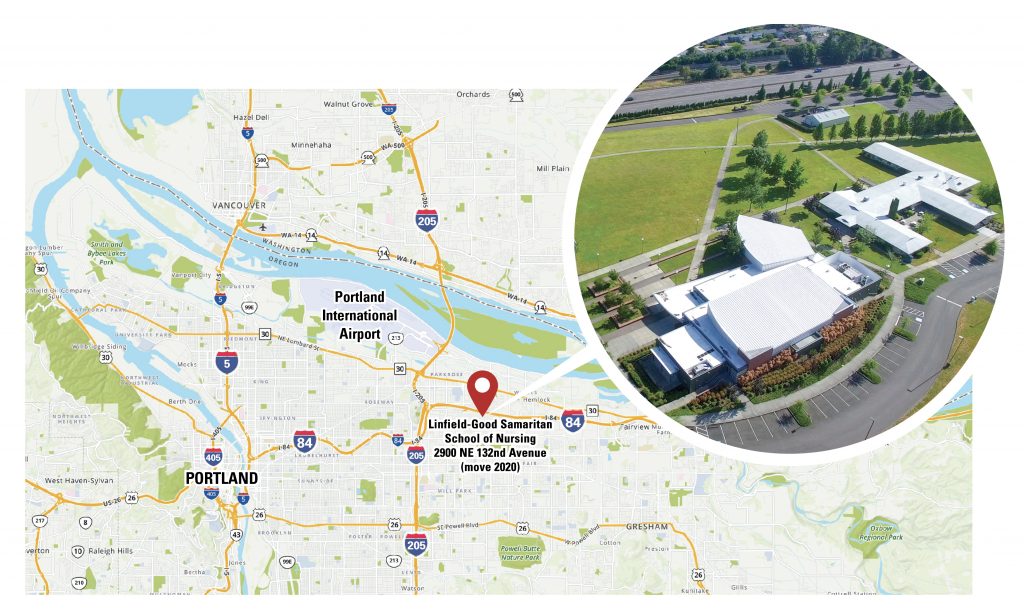 As Linfield prepares to open its new nursing campus, methods to shape the next generation of nurses will continue to evolve with a focus on collaborative learning and real world issues, says Kim Jones, dean of nursing at Linfield.
One change features “flipped classrooms” where students learn content online before class, and spend class time discussing and solving problems. Nursing education is also moving toward problem-based learning, where students react to patient scenarios, and active learning classrooms featuring moveable seating, digital whiteboards and mobile devices.
“Linfield’s new nursing campus will give us the flexibility to continue adapting to the needs of educating nurses well into the future,” says Jones.
– Christian Feuerstein


