
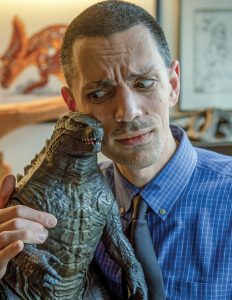
 When Godzilla: King of the Monsters! opens in theaters May 31 it will be the 35th Godzilla film produced since 1954. Why do the films continue to resonate across generations? Leonard Finkelman, assistant professor of philosophy and a paleontologist, weighs in on what monsters tell us about ourselves – and our world.
Godzilla: King of the Monsters! The title brooks no dispute among the giant reptile’s fans. Moviegoers continue to respond to Godzilla’s siren call — officially transcribed “SKREEONK” — after 35 films spread across 65 years. Through that time Godzilla has defeated multiple contenders for the kaijū (literally, “strange beast”) throne, hence the royal title. But we may bestow the crown for another reason as well: Godzilla remains the classic monster. As the world’s greatest dangers have changed since 1954, Godzilla has evolved as a symbol of humanity’s existential threats.
Indeed, the specter of doomsday looms over Godzilla’s screen appearances. The monster’s first film premiered in Japan less than a decade after atomic bombs destroyed Hiroshima and Nagasaki. Audiences haunted by mushroom clouds recognized a message encoded in Godzilla’s origin as a dinosaur mutated by atomic fallout: mankind was as helpless before nuclear weapons as Tokyo beneath the heel of a 50-
meter-tall fire-breathing dragon. The symbolism later proved to be malleable enough to represent other potential end-of-the-world scenarios. From global arms proliferation (Destroy All Monsters, 1968) to environmental crises (Godzilla vs. Biollante, 1989) to the failure of techno-optimism (Godzilla Against Mechagodzilla, 2002), each potential doomsday is another opportunity for Godzilla to show us the monsters waiting to raze our civilization to the ground.
It is therefore fitting that Godzilla emerges again as we face new threats. The problems our world faces now (climate change, sociopolitical unrest, etc.) are so complex that they can only be resolved through extensive interdisciplinary collaboration. Our survival depends on our ability to work together. In this sense, today’s monsters are the ones that Aristotle called out in his treatise on politics, wherein he wrote: “he who walks alone in society, or who has no need for others because he is sufficient for himself, must be either a beast or a god.” In other words, isolation — whether through breaking of social bonds, elevating oneself above others or lack of empathy — is mankind’s greatest vice.
Isolation is also what makes Godzilla a monster in the most literal sense. In biological terms, a monster is any organism that can’t be classified in any species; monsters don’t swim in anyone else’s gene pool. Mutated nearly beyond recognition as a relative of long-extinct dinosaurs, Godzilla is forced to walk alone in the world (notwithstanding the inexplicable and largely forgotten additions of its wards Minilla, Godzooky and Godzilla Junior in earlier story lines). The monster’s lonely walk can destroy everything we’ve earned through previous progress.
At times when real monsters threaten the world, Godzilla offers us the opportunity to confront and manage our fears. We can beat back dread of the apocalypse for the price of a movie ticket. So we gather in the theater to thrill together at the king’s continued reign time and again. As we gather this time, we have an opportunity to reflect not only on the wicked problems that Godzilla represents, but also on the solutions to be found in the people sitting around us.
– Leonard Finkelman
Monsters in Marshall Theatre
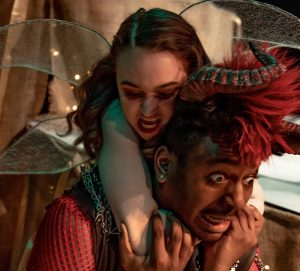 Monsters and the Monstrous is a reoccurring theme of the 2018-19 Linfield College Theatre season.
The productions ask pointed questions about who society considers to be monstrous and who the real monsters might be, says Lindsey Mantoan, assistant professor of theatre and Linfield’s resident dramaturg.
“Overlapping themes raise questions about what it means to be human, where we come from and where we hope to go,” she adds.
“They often mark moments of rupture or cultural unrest, even as they represent the culmination of political, scientific and individual achievement. These pieces all ask who or what might be considered monstrous.”
Monstrous productions:
- Night of the Living Dead (Sept. 2018), based on the 1968 film of the same name, explored racial oppression in the United States – and what has and hasn’t changed since the civil rights movement.
- Dr. Jekyll and Mr. Hyde (Nov. 2018), set amid the rapid expansion of scientific knowledge in Victorian England, explored what kind of monsters lie within each of us and whether we chose to let them out.
- She Kills Monsters (March 2019) followed a high school teacher learning to better understand her dead sister by playing Dungeons & Dragons, unpacking the sometimes monstrous identities people assume.
- Cabaret (May 2019) is based in 1930s Berlin, Germany, on the brink of Hitler, and set against a backdrop of a nation monstrously divided by fear and hatred of those who are different.
linfield.edu/arts


