
 In 1939, Linfield College was in the midst of unprecedented growth. In the 15 years since a pair of donations had secured Linfield’s future (and given it a new name), the school constructed five buildings, modernized the curriculum and hit record enrollment. The 1938-39 student body numbered 592, and the graduating class of 99 was the largest in the school’s history.
But danger lurked.
An editorial in the Dec. 9, 1941, edition of The Linfield Review – two days after the attack on Pearl Harbor – was titled United We Stand and detailed the beginning of the transformation: “We are at war. Everything else in our lives as college students, as son or daughter, as brother or sister, friend or rival, is overshadowed by the sudden, stark realization of this fact.”
The campus population shrank quickly as students, faculty, alumni and trustees left to be part of the war effort. In all, more than 500 members of the Linfield community served in World War II. Linfield students who remained on campus read of classmates on European battlefields in the school newspaper. Ultimately, 25 members of the Linfield community were killed or ended up missing in action.
In 1941-42, the enrollment was 474. The next year, it fell to 324 and then bottomed out at 225 the year after that – 80 percent of whom were female.
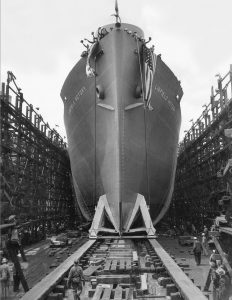
Students on campus formed a War Activities Council (WAC) to support the effort on the homefront. Members fundraised by selling bonds and stamps, held patriotic activities like the Victory Sing (Nov. 23, 1942), formed memorial funds for fallen classmates, organized blood drives and encouraged rationing efforts in the community. The WAC also led the effort to raise funds for the S.S. Linfield Victory, a liberty ship, which was commissioned by the U.S. War Shipping Administration and built to honor Linfield’s student veterans. Built in Portland and christened June 7, 1945, the cargo carrier arrived too late to help in World War II, but was later used in the conflicts in Korea and Vietnam.
In the 1943-44 school year, with the campus mostly female, Joecille (Fulham) Hoffman ’44 became the first woman to be the ASLC president since World War I. The forensics team, which had always been separated between men and women, became co-ed and earned 10 first-place finishes in intercollegiate competitions.
Despite the gains, these were lean years for Linfield. The reward for making it through them was the Servicemen’s Readjustment Act of 1944, also known as the GI Bill. Among its many benefits for returning veterans was tuition assistance; Linfield’s student body went from 305 in 1945-46 to 830 the next year and 973 in 1947-48. Donated surplus barracks from military bases were trucked to McMinnville to help house the surging population, and president Harry Dillin started a building fund which led to most of the residence halls on today’s campus.
Returning veterans and the booming enrollment helped loosen ties to the most conservative element of the Baptist church. After many years of students pushing for it, dancing was finally permitted on campus in 1946.
To keep up with the increasing student population, the faculty grew quickly, as well – 37 new faculty members were added by 1948. Among the new hires were names that ended up being noteworthy in Linfield history, including Walter Dyke, Win Dolan, Gordon Frazee and Paul Durham.
The campus changed in other ways, too. Many of the students were older, married and starting families – entire residence halls were set aside for married students. The University Dames, a club made up of Linfield women, sponsored baby shows on campus that attracted national attention. Linfield’s athletic success began to take off under the leadership of Durham, Hal Smith, Roy Helser and others. Fraternities and sororities began to push for national affiliation – previously against school rules – and the first to become affiliated was Theta Chi (formerly Alpha Gamma Nu) in 1949.
Rapid growth in the wake of the war years propelled
Linfield College forward more quickly than ever before. A new era had arrived.
– Rich Schmidt, Linfield College archivist


