
President Johnson reflects on her second time around as an interim leader
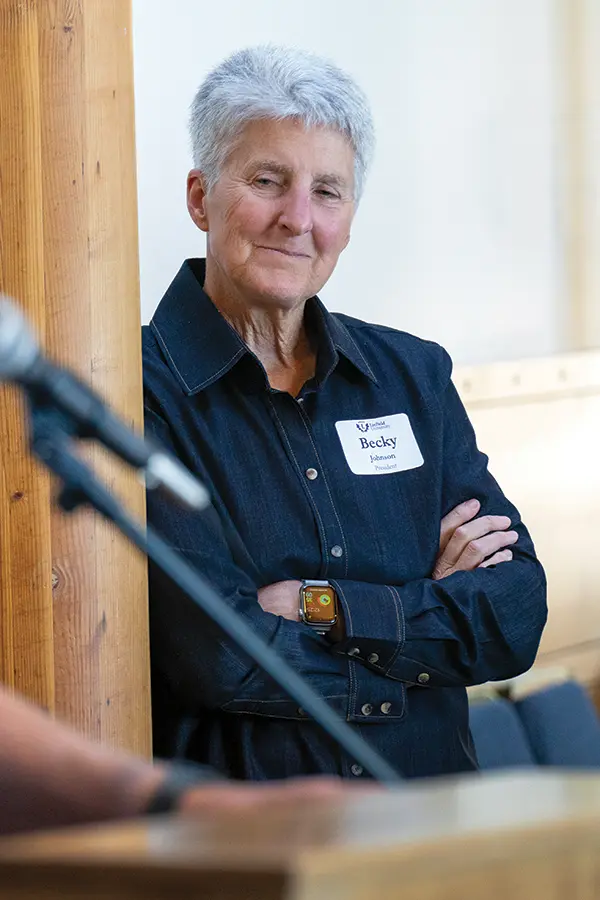
Rebecca “Becky” Johnson spent virtually her entire career – 37 years – at Oregon State University, rising from assistant professor in the College of Forestry to the presidency, becoming the first woman to oversee the institution. It’s surprising for Johnson, then, to find herself answering questions about what it’s like to be a short-time leader.
“It’s kind of strange,” she acknowledged, while discussing how she became interim president at two different universities, and how an interim role differs from being a permanent hire in the corner office.
When then-OSU President F. King Alexander resigned abruptly in the spring of 2021, Johnson was leading the university’s Cascades Campus in Bend. The board of trustees turned to her to bring stability to its campuses at a fraught moment. She spent the next year and a half as interim president before announcing her retirement in September 2022.
Retirement, though, didn’t last long. When President Miles K. Davis resigned in late 2023, the Linfield University board went looking for an experienced interim president to lead through a transition period. It found one nearby in Bend, where Johnson had settled down in retirement with her wife, Lori Elkins.
“I wasn’t looking for another job,” Johnson said, “but I was looking for something of purpose to do in retirement.”
Bob Carlson, president of the interim-placement arm of organizational consulting firm Korn Ferry, has been helping recruit and place interim CEOs and high-level executives at for-profit and non-profit organizations for three decades. He says the skills that make a good interim leader and the mandate they are given differ from someone being hired to do the job long-term.
“If someone is going to be important for the next 15 years, you’re looking for some things in addition to the technical skillset. You’re looking for someone who has upward mobility for evolving into more than they are in their current form,” Carlson said. “You’re not as concerned about that for an interim. You’re hiring a set of skills and experiences that are quite specific.”
He says interim CEOs and presidents generally have a particular mandate from the board of trustees (or board of directors) about what needs to be done over a relatively short amount of time, and they need to hit the ground running.
“They don’t get the same grace period or honeymoon period that a permanent person would,” Carlson said.
Johnson says that was the case when she was hired as Linfield’s interim president. The board was clear that the university’s structural deficit, pattern of declining enrollment that began in the early 2010s and lingering distrust in the administration by some factions of the faculty were areas that would need to be addressed.
Johnson says she found a number of strengths and opportunities at Linfield that have outweighed the challenges. A strong and experienced board is populated with people who are deeply committed to the university, and faculty and staff members are uniformly focused on student success. Recent recruitment classes have also diversified the student body in a way that reflects the surrounding region. In particular, Linfield has done a good job recruiting first-generation students, who can benefit greatly from Linfield’s deep-rooted support network.
Part of her job, as Johnson sees it, is setting the next president up for success.
“One thing I learned from my interim presidency at OSU was that people need a calm, transparent leader after going through some turmoil,” Johnson said. “And I learned that people need to be reminded that, despite some hard times, the core of the institution hasn’t changed – the same strong faculty and staff are doing all the great things they have always done. We just needed to put the focus back on that.”
There are some things an interim president shouldn’t do, Johnson says, like embarking on a new strategic planning process or a new capital campaign. Long-term initiatives like that should be left to a long-term leader.
But the interim president shouldn’t just be a placeholder, she says – the role contains the full power of the presidency, and the university has important issues to address here and now. It’s a delicate balance.
Ultimately, Johnson says, the president’s job – interim or otherwise – is about helping the community succeed. It’s about the rest of the people at the university as much as it is about the person sitting in the president’s chair.
“One of the most difficult things about being an interim is developing a lot of new relationships, with employees, students, donors and other external constituents, knowing that my time at the institution is going to be short,” she said. “At OSU, that part of the job was easier because I already had those relationships. As an interim president here with no previous connection to Linfield, it could have been difficult. It was made far easier by the great faculty, staff and members of the leadership team who care so deeply about this place. People have been willing to dig in to address our challenges, and they have an optimism about the future.
“The incoming president,” she said, “will be fortunate to be joining such an institution.”
Presidential search timeline
The search process for Linfield’s next president is proceeding, with a strong group of qualified applicants. The updated anticipated timeline for the process is:
- OCT. 4
- Preferred filing date for interested applicants.
- MID-OCT.
- Search committee members met to select semi-finalists.
- OCT. 31
- First round interviews over Zoom completed with semi-finalists.
- EARLY NOV.
- Search committee chose finalists.
- MID-NOV.
- Finalists invited to Oregon for on-campus interviews.
- BEFORE END OF 2024
- Announcement of new president.
The most up-to-date information is available at linfield.edu/presidentialsearch
A look at Linfield’s interim history
Learn more about the institution’s former acting and interim presidents


