A look at the 100-year history of Linfield’s mascot

It was a celebration a century in the making. Mack wore a special jersey bearing the number 100 during the Oct. 12 homecoming game, fans received commemorative hats and t-shirts, and of course, there was cake. Linfield celebrated its 100th year of being known as the Wildcats with a lineup of festivities fit for the occasion.
Interestingly, it was a far cry from how Linfield first adopted the nickname. Records are limited about how the Wildcats became, well, the Wildcats. It isn’t known if there were choices or a debate, but a small column on the bottom of the Dec. 3, 1924, edition of The Linfield Review simply read:
Athletic nickname. “Wildcats” is the new name which will strike terror into the hearts of Linfield’s antagonists in future athletic games.

The associated students Wednesday morning selected the name “Wildcats” as the official nickname for Linfield’s teams, since it is a small school with a lot of fight and scratch.”
Much has changed in the last 100 years — buildings erected and torn down, school name changed (from college to university), generations of people have come and gone — but through it all, the Linfield community has united as Wildcats.
’Cat Fact #1
Athletic teams were previously referred to as the “Baptists,” the “Cardinal and Purple” or “Old Mac.” Often, sports writers simply used the school’s name.
What’s in a name?
That’s not to say the story of the Wildcats is a simple one. Inconsistencies have run rampant, even from the day it was announced. That same Dec. 3, 1924, edition of The Linfield Review featured stories with the spelling “Wildcats” and “Wild Cats.”
Women’s athletic teams over the years have been called the “feminine Wild Cats” in 1924, “Wildkittens” in 1963 and Lady Cats in the 1980s. Also used regularly in the Linfield vernacular is the ever-popular Cats or ’Cats.
In the world of college mascots, the Wildcat is not unique. In fact, in 1998, it was listed among the top 12 nicknames used at colleges and universities in the United States, behind several other felines, including tigers, panthers, lions and cougars. Today, the ‘cat’ category makes up roughly 16% of all American college nicknames. While Linfield is bordered by Wildcats to the north at Central Washington University and to the south at California State-Chico, most cat-themed college mascots are located in the Midwest and eastern United States.
’Cat Fact #2
The Chico State student body also voted to become the Wildcats in 1924, and CWU adopted the mascot in 1926.
What is a Wildcat?
Early renderings of the school’s favorite feline can be found throughout Oak Leaves, Linfield’s yearbook, starting in 1925. The 1935 and 1938 covers feature an embossed (and rather toothy) Wildcat, while the pages of several utilize a variety of hand drawings in the pages, ranging from detailed cartoons to more realistic line sketches.
The college logo and seal during the early 1900s used images of the Old Oak or a book. It took until the middle of the century for Linfield (or at least some of its organizations) to use a common image of the Wildcat.
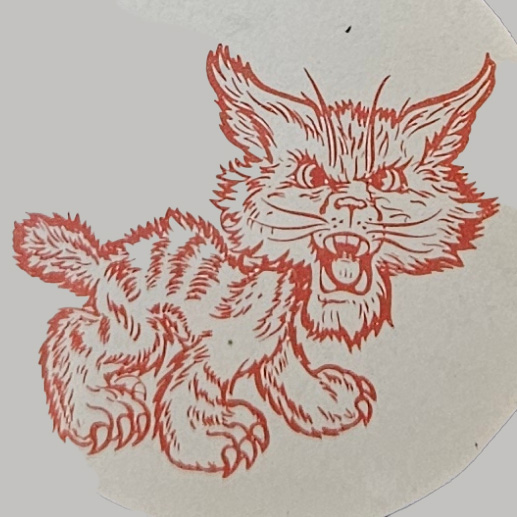
Even then, the depictions ranged from cats that resembled mountain lions or bobcats to the common (and sometimes angry) housecat. A window decal produced in the 1940s shows a screaming Wildcat — resembling a cougar — on top of the words Linfield College. This same artwork was being used in 1963 in a Linfield Review advertisement selling Wildcat checkbook covers.
’Cat Fact #3
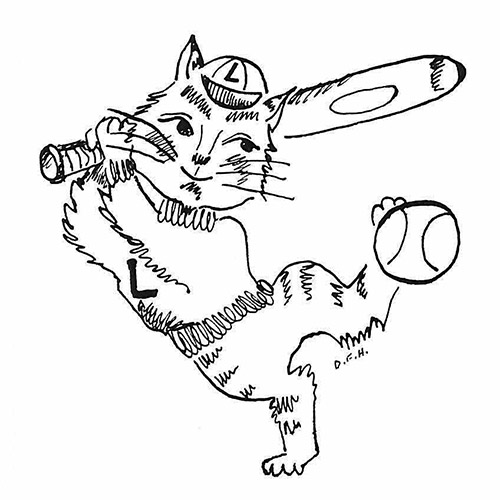
Editor Dolores (Harris) Laners ’57 drew 10 cartoon wildcats that are sprinkled throughout the 1957 Oak Leaves. See more in the digital yearbook collection at digitalcommons.linfield.edu/yearbooks.
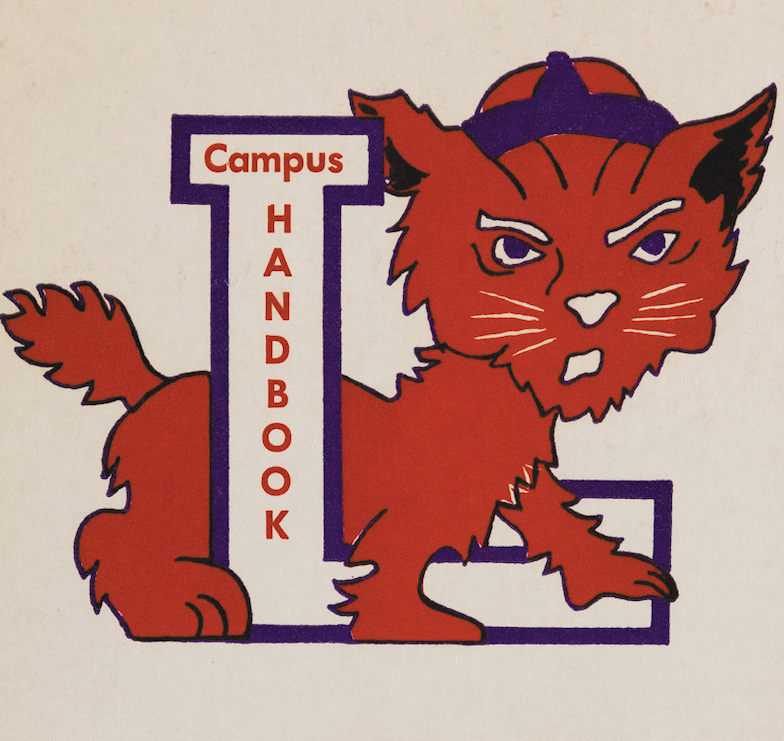
But there were other Wildcats. A Campus Handbook from 1950-51 used a full-bodied, scratchy looking Wildcat wrapped around a block L. Yell leaders throughout the 1950s and 1960s would use this image on their sweaters, which also seemed a favorite for retailers.
There was a cross-eyed bobcat head, another used by song leaders with a mischievous grin and a full-bodied snarling Wildcat used between the 1960s and 1980s.
Sporting a new look
A more consistent look for the Wildcat, and the athletic department logo, emerged in the 1960s.
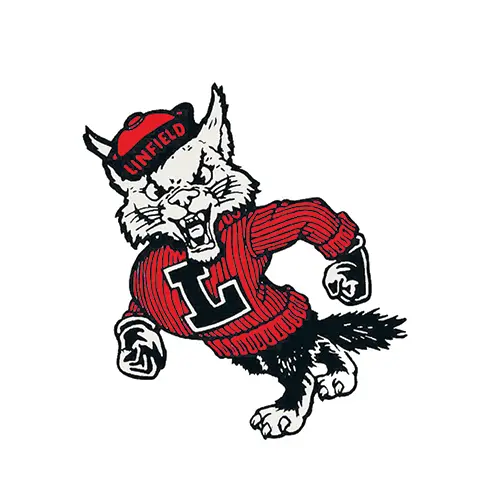
Charlie Sheckler ’66 designed and painted a sign displayed under the Maxwell Field scoreboard in the summer of 1961. The Wildcat he used bears a striking resemblance to today’s athletic logo, with the snarling face and sailor hat. It is the first documented use of the Wildcat used to this day on Linfield uniforms and on a wide variety of merchandise.
A more refined version appeared as decals on the football team’s helmets in the 1963 season under head coach Paul Durham ’38. In a letter dated January 2004 to Tim Marsh ’70, Durham wrote “About the helmet decal – I remember nothing except that it looks like a Disney wildcat, which I think is distinctive and great.”
’Cat Fact #4
The Walt Disney Company is responsible for several collegiate mascots created in the 1940-50s. In addition to the University of Oregon Duck, Disney produced mascots for the University of Denver, University of Missouri, Point Loma College and the College of Staten Island.
The genesis of the logo as we know it now has long been unverified. Potter Manufacturing, a Eugene-based company from 1923 to 2023, created the helmet decals, which were also sold in the Linfield Bookstore. Potter Manufacturing was also a major supplier of the University of Oregon bookstore until its closing. It is not far-fetched to believe a designer at Potter created the logo that was then used and sold on campus.
Another popular collegiate mascot designer of the time was Arthur Evans, who served as art director for Angelus-Pacific Company in Fullerton, California, for 45 years. Historian Roy Franks called Evans “the most prolific cartoonist” and attributes at least 90% of the college mascots created between 1932-77 to Evans. He created the Washington State College Cougar, the University of Idaho’s Joe Vandal, Oregon State University’s Benny the Beaver and UCLA’s Joe Bruin, among others. Hallmarks of Evans’ designs include a small V-shaped notch in the eyes, emotional facial expressions (usually angry), and a tilted sailor hat.
’Cat Fact #5
Why a sailor hat? Some believe it’s a tribute to beanies that were popular for underclassmen to wear on college campuses. Others believe Evans added sailor caps in homage to his time as a merchant marine.
The Angelus-Pacific connection to Linfield takes on more gravity if you compare the company’s logo for Northwestern University (also the Wildcats) seen in a 1963 trade ad to the full-bodied snarling Wildcat used for merchandise sold in the Linfield Bookstore between 1966-80. The images, though reversed, are identical.
Tim Waddell, former president of Angelus, explained in a 2013 interview that Evans would draw a character, and the company would sell it to college bookstores repeatedly. It was a time before trademarking and licensing were the norm (this would come in the late 1970s). Waddell also said, “other printers also copied Arthur’s designs and sold them not only to schools but to anyone who wanted a mascot.”
’Cat Fact #6
The term “mascot” comes from the French “mascotte,” meaning lucky charm. It came to the United States in the 1880s thanks to a French opera, “La Mascotte.”
Regardless of its origination, Linfield Athletics has used essentially this logo since the 1960s. That’s not to say it hasn’t evolved. Between 1963 and 1975, athletic department publications used logos that sometimes included “LC” on the brim of the sailor hat rather than just “L.”
Ed Langsdorf, the football coach from 1980-2000, updated the original red and black logo to purple and cardinal in 1992. He told the Wildcatville blog via email in 2004: “The reasons were strictly cosmetic. I thought the logo was a little difficult to see at its former size and the black really wasn’t part of our uniform color scheme in any way.”
A university-wide rebrand in 2010 with the firm Brand Navigation modernized the logo by simplifying the lines and adding a gray outline for easier reproduction. The most notable changes, however, were uncrossing the Wildcat’s eyes and evening out the number of whiskers to five on each side.
Modern Wildcat evolution


PUTTING ON HIS GAME FACE: The Wildcat logo used by Linfield Athletics has undergone rounds of edits since its inception in the 1960s.
Bringing the Wildcat to life
Popularity for costumed mascots arose in the United States in the 1960s, thanks to the emergence of the New York Mets’ Mr. Met in 1964 and the Ohio State Buckeyes’ Brutus Buckeye in 1965. Historian Roy E. Yarbough described mascots as “an identity, a source of entertainment, a rallying point.” Former Wildcats agree.
“A logo like the Nike swoosh is a symbol of something larger than yourself. A mascot is the physical embodiment of the institution. It brings awareness of the institution,” said Timothy Love ’07, who served as the Wildcat mascot for four years.
At Linfield, the first mention of a costumed mascot on the Linfield sidelines appears in the 1950 edition of Oak Leaves. A short paragraph about the accomplishments of the Spurs service organization that year reads, “Spurs have worked hard … making the wildcat outfit which will be Linfield’s mascot …”.
However, photos of a Wildcat costume do not appear in the archives for more than 20 years. The first one is identifiable in the 1974 Oak Leaves, showing a person wearing a paper mâché Wildcat head.
’Cat Fact #7

This picture of a paper mâché Wildcat was taken by Reid Blackburn ’74, who was killed in the 1980 volcanic eruption of Mount St. Helens.
This was followed in 1978 with a full-body costume reminiscent of an adult onesie pajama. This costume, a far cry from today’s Wildcat, showed the student’s face, which was painted with a nose and whiskers. As their identity was not hidden, the student mascots participated in cheers and chants with the spirit squads.
Though they would be identified in several yearbooks, future Wildcats began to perform with an air of mystery starting in 1986. A new costume was unveiled at a football game that year with a toothy, smiling Wildcat jumping out from underneath a giant gift box.
By this time, the Wildcat was a regular fixture at Linfield football games and occasional basketball contests. Fans — especially the youngest Wildcats — responded positively to the mascot’s presence.
“All the kids would come up and take photos,” remembered Susan Greenwood ’90, who was the Wildcat for two years. “The funny part is I would be inside grinning even though no one could see it.”
’Cat Fact #8
Greenwood often did cartwheels as the Wildcat. She ended up sewing an elastic band into the costume to keep the head secured when doing stunts.
She loved being “wild and crazy” in the suit and bringing a sense of camaraderie to Linfield, she said.
“I would interact with the next generation of fans,” she remembered. “They had the most fun with the mascot.”
Bridger Hayes-Lattin ’22 agreed. “I loved seeing all the alumni and families light up when they saw me, especially alumni,” he said.
Jake Jenkins ’20 believed the ability to unite fans and connect with people the best part of the role.
“Mascots connect people,” he said. “People will come back for 40-year anniversaries and look for the mascot. I have pictures as a 9-year-old with the Wildcat, and then later, there are pictures with me in costume with 9-year-olds.”
Suits of many Wildcats
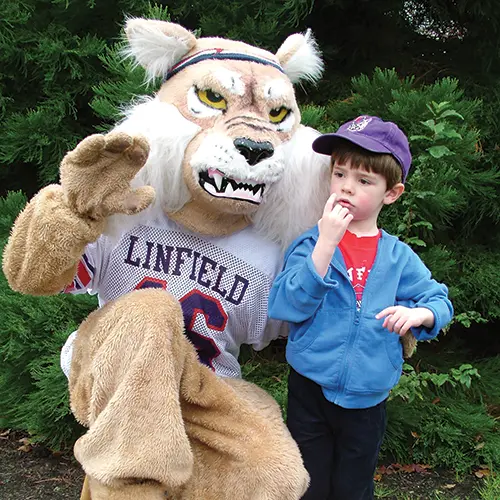
The costume changed over the years, most notably in 1998, 2006 and 2019. The Wildcat’s facial expressions ranged from happy to angry and fierce. Sailor caps came and went (and came back again). There was also a quick chapter where the Wildcat often wore an athletic headband.
Tony Carpenter ’98 is responsible for the Wildcat finally wearing clothes.
“I took one of Sean Stortzum’s [’98] jerseys from the laundry room to wear over the costume,” he remembered. “It needed more school spirit.” Oak Leaves from the time show the Wildcat donning a number 38 jersey. In 2017, the Wildcat started wearing a football jersey with the year of The Streak, a tradition that continues to this day.
But that’s not to say all he wears is a jersey. The Wildcat has been known to dress for the occasion. Throughout the years, he has worn Santa and Easter Bunny costumes, various t-shirts, a kilt at the McMinnville Scottish Festival and even a handcrafted Speedo.
’Cat Fact #9

Jake Jenkins ’20 fondly remembers when Mack switched his jersey to the number 64 when The Streak extended, which was his brother’s football number. Photo by: Timothy D. Sofranko
What’s in a name? (Part two)
Known for decades simply as the Wildcat, Linfield’s mascot finally received a name in 2014, 90 years after Linfield adopted the Wildcat nickname. Dan Fergueson, then director of college activities, led a Name the Wildcat contest.
The name “Mack” was announced in May of that year.
“Mack is such a part of the community,” Jenkins, who was the first to be called Mack, said. “It is a fitting name as Linfield and McMinnville are so connected.”
Some of the other former Wildcats shared what their other ideas had been from Winfield (“because we WIN”) to Willy or Linnie.
The walk, the (non-verbal) talk, the antics

Regardless of being called “the Wildcat” or “Mack,” students in the suit have a pretty unified idea of who he is and how he acts.
He is an actor. As Love said, “Being a mascot is an art – its theatre, it’s pantomime. You do things that as a normal person you would never do. When you’re dressed, it’s expected. You over-exaggerate everything because you are selling an idea.”
He also balances confidence with comedy.
“I always wanted him to swagger, puff his shoulders out and be the ‘big man on campus’,” Jenkins added. “He has swagger, but jokes around, trips and makes kids laugh.”
But mostly, he is Linfield’s biggest supporter. “The Wildcat personality is enthusiastic. He is the team’s number one fan,” Greenwood said. “It didn’t matter what sport; the Wildcat is the number one fan.”
And that is something that won’t change in the next 100 years.
“In athletics, the coaches change, and the players change. The mascot doesn’t,” Jenkins said. “He may improve or get work done, but he is always going to be there.”
Special thanks to the Linfield Archives and Special Collections, especially Annette Castillo-Rodriguez ’25. Also to Kelly Bird, Tim Marsh ’70, the former Wildcats and “Inspired Pragmatism.”
The Wildcats behind the mask
Due to the mystery behind mascot identity, former mascots are not always recognized for their service. Thank you to these Linfield alumni, who donned the Wildcat costume and were a special part of Linfield history.
- Tina McCormick ’85
- Ashley (Heinrich) Sage ’88
- Susan Greenwood ’90
- Alex Woodward ’92
- Tony Carpenter ’98
- Timothy Love ’07
- Bryce Borland ’12
- Jake Jenkins ’20
- Bridger Hayes-Lattin ’22
- Abram Nelson ’24
Were you also the Wildcat? Let us know! Email linfieldmagazine@linfield.edu
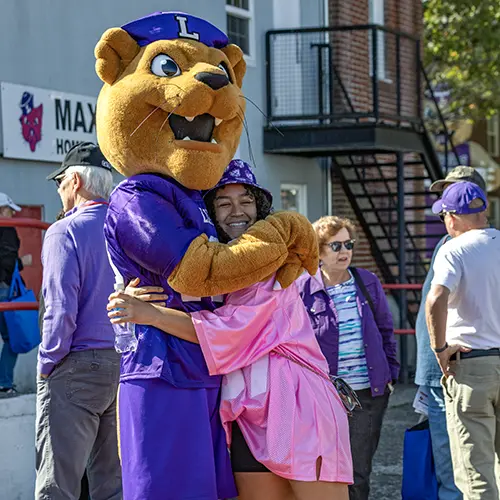
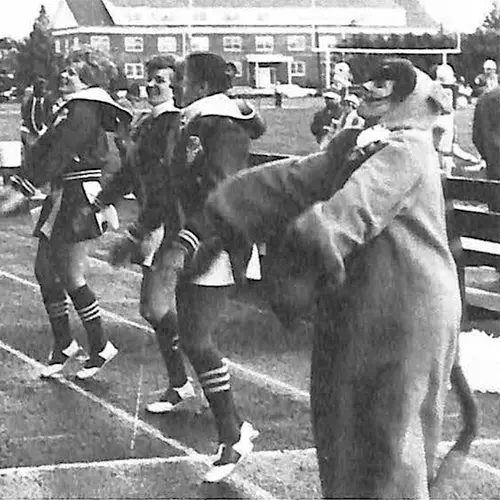
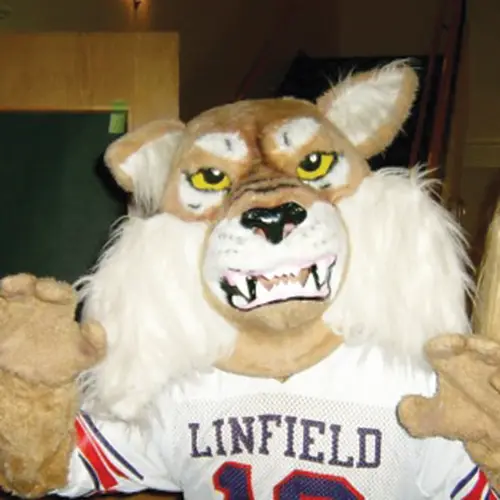
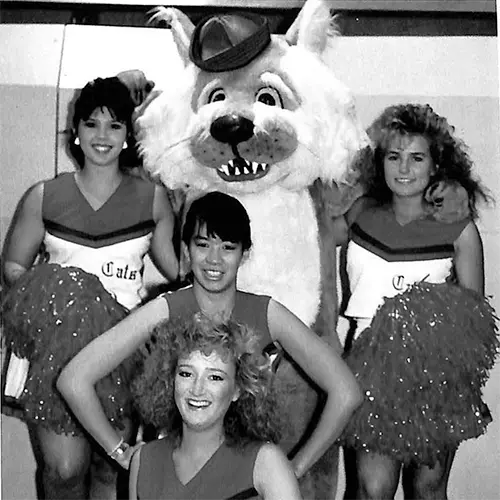

CH-CH-CHANGES: Time may change the ’Cat, but old photos in the Linfield Archives trace the evolution of the costumed version of Linfield’s mascot. Learn more about the origination of the Linfield Wildcat – in name, logo and costume – in the story, “Celebrating a wild(cat) century,” on page 12.


