
Birthing manikin provides new clinical simulations for nursing students
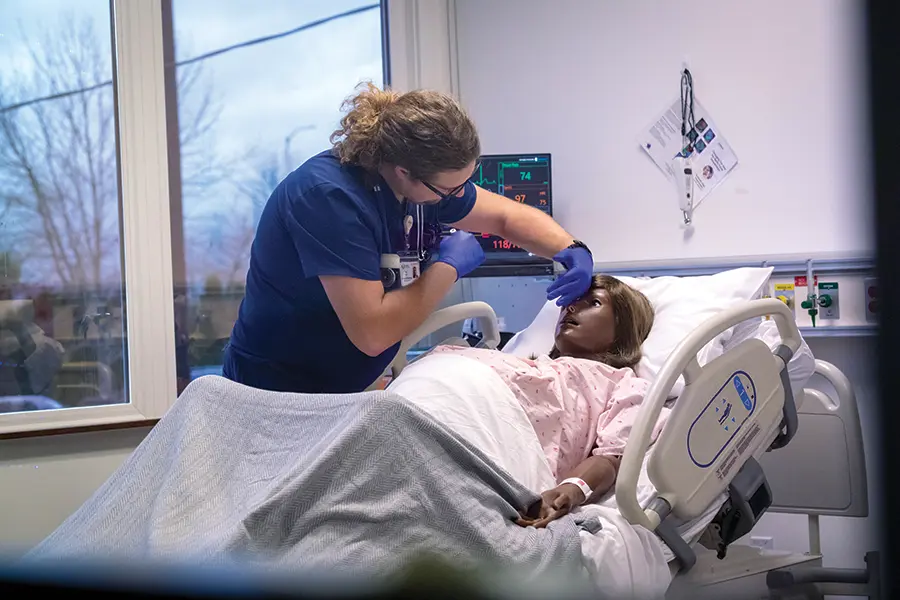
“Hi Noelle, I’m Billie, I am your nurse,” the student said. “How are you feeling today?”
A voice projecting from Noelle complains of a headache and feeling fatigued.
“I’m going to check your vital signs and give you a head-to-toe assessment,” Billie Melchor ’24 explained as she placed one hand on the manikin’s arm in a gesture of comfort.
Melchor is among the first Bachelor of Science in Nursing students participating in a new simulation in the Family Birthing Center in the Linfield-Good Samaritan School of Nursing’s Experiential Learning Center. Another student in the back of the room tends to a newborn baby manikin crying faintly on a pediatric table.
Unlike the previous simulations that day, this one involves a pregnant manikin and her newborn baby. Other than knowing it involves a labor and delivery manikin, students entering the room have no idea what scenario they will be presented with.
In March 2023, the E. L. Wiegand Foundation awarded Linfield a grant of which approximately $73,000 supported the School of Nursing’s purchase of the fully-functioning, high-tech maternity labor and delivery mother and infant manikins, named Noelle and Newborn Tory.
“Noelle has so many features that add realism to simulation and have made a variety of clinical scenarios possible for learning. Noelle has high-tech features that can simulate pupil dilation, seizure activity, active bleeding and fundus firmness, to name a few.”
–Assistant Professor Emily Rios
The E. L. Wiegand Foundation makes grants to qualified charitable organizations for programs and projects having significant impact in areas including education and medical research. In total, the grant was $122,290, with the remainder awarded to the Department of Health, Human Performance and Athletics to supply high-tech sensory equipment for the Master of Science in sports science and analytics program.
Noelle and Newborn Tory were used in limited-simulation scenarios during the summer, and then students in all three of Linfield’s on-campus nursing programs began using their full features in early November.
“Noelle has so many features that add realism to simulation and have made a variety of clinical scenarios possible for learning. Noelle has high-tech features that can simulate pupil dilation, seizure activity, active bleeding and fundus firmness, to name a few,” said Assistant Professor Emily Rios, who uses the high-fidelity manikins in her courses with third-semester students. “Students have been able to perform important assessments and intervene in obstetric crises in a safe learning space.”
Noelle is a dark skin tone labor and delivery patient simulator, while Newborn Tory is a newborn full-term neonatal simulator. Noelle’s features include several different bellies, a spot on her spine for an epidural, a placenta and three non-mechanical baby manikins. She can say limited phrases like, “Ouch! That hurts,” while Linfield’s simulation operation specialists can voice additional phrases through a built-in speaker. She can have a breech birth, require a c-section, have a seizure and postpartum hemorrhage or go into cardiac or respiratory arrest.
Students can practice chest compressions, resuscitation and intubation on Newborn Tory. He stores data such as vital signs and CPR measurements, which are reviewed with the students during their debrief. The three non-mechanical babies are used for scenarios that involve complications or delivering twins.
“This simulation was more intense than the others. I felt nervous at first. There’s a lot to pay attention to,” Melchor said following the half-day exercise. “Our team prepped really well, though. We used good communication and delegated tasks in order to tend to both patients.”
Noelle and Newborn Tory give nursing students experience in a wide variety of childbirth situations. This includes:
• Amniotic fluid embolism
• Assisted deliveries using forceps
• Breech vaginal delivery
• C-section delivery
• Different birthing positions
• Epidural procedures
• Episiotomy repair
• Neonatal resuscitation
• Normal vaginal delivery
• Placental abruption
• Postpartum hemorrhage
• Preeclampsia
• Prolapsed cord
• Shoulder dystocia


