
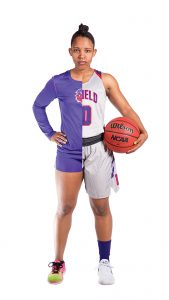
 Jade Everage ’18 is busy. The communication arts major, campus leader and two-sport athlete doesn’t have much wiggle room in her schedule. Still, she’s happy she chose this path – even if it did take her a while to figure out how to manage it all.
“Balancing two sports, school and extracurriculars is a skill I did not acquire until last year,” says Everage, who came to Linfield from southern California. “Playing more than one sport allows you to see all aspects of competition, whether it takes a single person or a whole team. It is very applicable to a professional future in any career field.”
Multi-sport athletes like Everage are becoming less common across the nation, and it’s a trend of growing concern to coaches and others. Early specialization in sport has been linked to overuse injuries and burnout at an early age. But at Linfield, and in Division III athletics, there is support to buck that trend.
Basketball coach Casey Bunn-Wilson encourages Everage and other students to participate in multiple activities, even sports.
“We have five dual-sport athletes on the women’s basketball team,” Bunn-Wilson says. “They are disciplined, organized and focused more (than other students) throughout the entire year.”
At the NCAA Division III level, 6.3 percent of student-athletes play more than one sport. That compares to 1.9 percent at Division II and 0.5 percent at Division I.
Wildcat coaches say they look for multi-sport athletes when out on the recruiting trail, even if they don’t plan to continue playing more than one sport in college. Many, though, do appreciate having that choice.
The option to play more than one sport, says football coach Joseph Smith ’93, “is one of the strongest advantages of DIII.”
Many Linfield student-athletes agree.
“I came to play football and being able to continue in track and field became a pleasant surprise,” says Ryne Fuhrmark ’18, an exercise science major. Fuhrmark also competed in both sports for four years at Williams Field High School in Gilbert, Ariz.
Many athletes, especially at higher levels, believe they must specialize in a sport in order to earn a scholarship or have a shot at playing professionally. According to the Aspen Institute and the NCAA, however, there is no data to support the conclusion that specializing in one sport increases the odds of a college scholarship or becoming a professional athlete.
Physical and mental benefits
Linfield coaches like the physical and mental advantages that playing more than one sport brings to the student-athlete.
Bunn-Wilson sees the on-court advantages for her players, and also believes it can keep an athlete from burning out on one sport.
Smith echoes this. “Multi-sport athletes in high school are able to compete year round, but because the sport changes they stay healthier by avoiding over-training,” Smith says. “Plus, they develop more skills.”
Multi-sport athletes are often more prepared to learn quickly and perform under pressure thanks to increased time in competition across different seasons.
It isn’t just coaches at the DIII level who covet multi-sport athletes. In a January 2016 interview with The New York Times, on the eve of playing in the BCS College Football National Championship, Clemson University head coach Dabo Swinney talked about the advantages of the well-rounded athlete. “I want the multi-sport guy. I just love that,” he said.
Active across Linfield’s campus
In addition to basketball and track and field, Everage is the president of the Linfield Black Student Union, competes on Linfield’s speech and debate team and represents students on the Diversity Advisory Committee. Fuhrmark, meanwhile, is active in his fraternity and works in the Financial Aid office.
Being involved is a trait Bunn-Wilson recognizes in many of her student-athletes. “Several of my student athletes tend to join clubs, or get involved in off-season activities around campus because they are happier when they are busy and have a lot going on.”
Time management is the key, which both coaches and athletes stressed. “As long as you budget the time around your sports, it is easily manageable,” Fuhrmak says. “Have fun and pour your heart into all of the sports you decide to compete in.”
Everage concurs, adding that being able to say ‘no’ to things and surround yourself with supportive friends, professors and coaches, makes a difference. “Find a group of people you can count on,” she adds.
For Smith, that multi-sport athlete can be a diamond in the rough. “When you find young athletes that have been successful in three sports, and they are a strong student with high character,” he says, “well, that is a student you want to have in your program.”
– Kevin Curry ̓92


