
A look at the evolution of on-campus student health
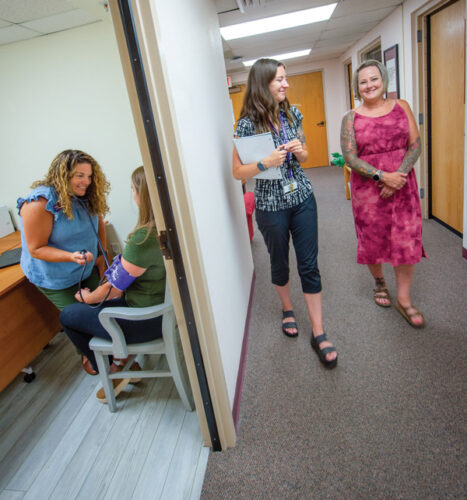
Linfield’s Student Health, Wellness and Counseling Center (SHWCC), which became a university focal point during the pandemic of the last few years, was first created during an earlier epidemic: HIV and AIDS.
As AIDS swept across the planet in the 1980s, health officials scrambled to find answers and make recommendations. In 1986, U.S. Surgeon General C. Everett Koop issued a public document titled, “The Surgeon General’s Report on AIDS.” In it, Koop recommended a comprehensive program of sex education and encouraged the widespread use of condoms.
Linfield students began advocating for on-campus condom dispensers shortly thereafter. The Board of Trustees complied with their requests but with the proviso that the campus should have more than condoms; education needed to forefront the movement. This resulted in Linfield opening its on-campus health center in partnership with the Physicians Medical Center in the late 1980s.
“The idea that students could live with chronic medical conditions and go to college and that health care providers could communicate through different systems… became more realistic,” explained Patricia Haddeland, the recently retired SHWCC director. “As students with chronic medical conditions started coming to college, we needed more help, we added more staff and we just grew from there.”
What started as a glorified condom-dispensing machine has grown to a full-fledged medical office concerned with overall student mental and physical health. In that sense, Linfield’s SHWCC has followed the national trend as colleges and universities stepped up resources and services for students in recent decades.
A brief history
It’s not that no health centers existed prior to the 1980s, however. The first college health center in the United States opened in 1861 at Amherst College in Massachusetts. It was born at the time thanks to a growing European philosophy of “a healthy mind in a healthy body” for college-going students.
The 1918 influenza pandemic and the increasing campus student bodies after the First World War brought student health – especially at residential campuses – to the forefront again.
In 1920, the American College Health Association was founded to promote the interest and importance of on campus healthcare. That was really the beginning of the shift from campus centers focusing on hygiene programs and physical education to the type of medical-centered offices widely seen today.
Since the 1990s, most colleges have developed at least a first-phase student health center: a place where students could go to grab a bandage or diagnose a cold. Some have done far more than that.
As college-going populations grew, student fees were added to better fund the centers, which continued to adapt to changing needs. What were once seen as dispensaries evolved into comprehensive health care clinics.
Before the creation of Linfield’s center, students generally had to trek off campus to the Willamette Valley Medical Center, then located where Walgreens now stands on Highway 99 in McMinnville. As the only local hospital, its emergency room served as students’ primary medical provider. The hospital relocating to Highway 18, significantly farther from campus, also played a role in Linfield increasing the offerings at the student center.
Haddeland joined the health center in the 1990s, right after the clinic opened. She stepped in for the director’s maternity leave, and what was supposed to be a temporary stint ended up being a three-decade career.
Linfield’s evolution
Linfield has offered both medical and counseling services to students since the early 2000s. The departments merged in 2012, with counselors as Linfield employees, medical staff employees of the Physicians Medical Center and Haddeland employed by both. The contracted relationship allows the providers to communicate as a team to create the best care plan for students.
Haddeland said putting medical providers and counselors together under a single roof solved a lot of challenges in providing overall care for students.
“If we are sharing clients and patients, we need to be able to communicate together as a team and really look at our students from a more holistic model,” she said.
The demand for services has grown rapidly at Linfield and elsewhere, for all kinds of care. That demand increased further during and after the pandemic of recent years.
Linfield, one of the only universities in Oregon with an outsourced medical clinic, has some options not available elsewhere. The unique partnership with the Physicians Medical Center allows Linfield students access to resources such as an X-ray department and a full-service lab, which small colleges don’t normally have. The partnership also granted Linfield the ability to incorporate on-campus COVID-19 testing and ultimately, to bring students back to school during the height of the pandemic.
“Many colleges are stressed finding the resources to keep medical providers,” Haddeland said. The outsourcing partnership Linfield has, she said, makes the situation here “different from other universities.”
A look forward
As the world continues to move out of the pandemic years, Linfield’s center will continue to evolve. But it will be evolving without the guidance of Haddeland for the first time since the early ’90s.
Haddeland retired from her role as director of SHWCC this summer, but said she feels the next director has a good team and a solid foundation to work with.
“As is true with almost everything in life, there are trends and fads,” Haddeland said of student health care. She said Linfield’s SHWCC, though, will always be built around the concept of “total-body wellness.” That doesn’t change.


