
Q&A with Reverend Jeremy Richards and Rabbi Mel Young
Editor’s note: Since the time of this interview, the Office of the Chaplain has expanded its team to include an imam, who started in August. As the interview with the reverend and the rabbi occurred before the imam joined, we regret any unintentional oversight in not including him in this particular Q&A session. Linfield Magazine is committed to showcasing stories of the university community and looks forward to featuring Yosof Wanly’s insights and contributions in future articles.
A product of its times, Linfield was chartered by the Oregon Territorial Legislature as a Baptist institution in 1858. (It was right there in the name – the Baptist College at McMinnville.) Roughly 80% of U.S. colleges were church affiliated then, a figure that dropped to 20% by the beginning of the 21st Century. Remaining very in tune with the times, Linfield now refers to itself as having been “historically affiliated with American Baptist Churches USA.”
The then and now can offer a stark contrast. Throughout Linfield’s early history, it was almost impossible to tell the difference between college and church. Yet, if you ask the average student today, there’s a decent chance they might not be aware of the school’s Baptist roots at all.
Still, faith remains important to many Linfield students and employees. Jeremy Richards, who started in April 2022 as university chaplain and director of service leadership, is on a mission to help students connect with their spirituality and faith. Rabbi Mel Young was hired on a part-time basis in August 2022. The two, along with three student chaplains, have worked together to rebuild the chaplain’s office in the year since.
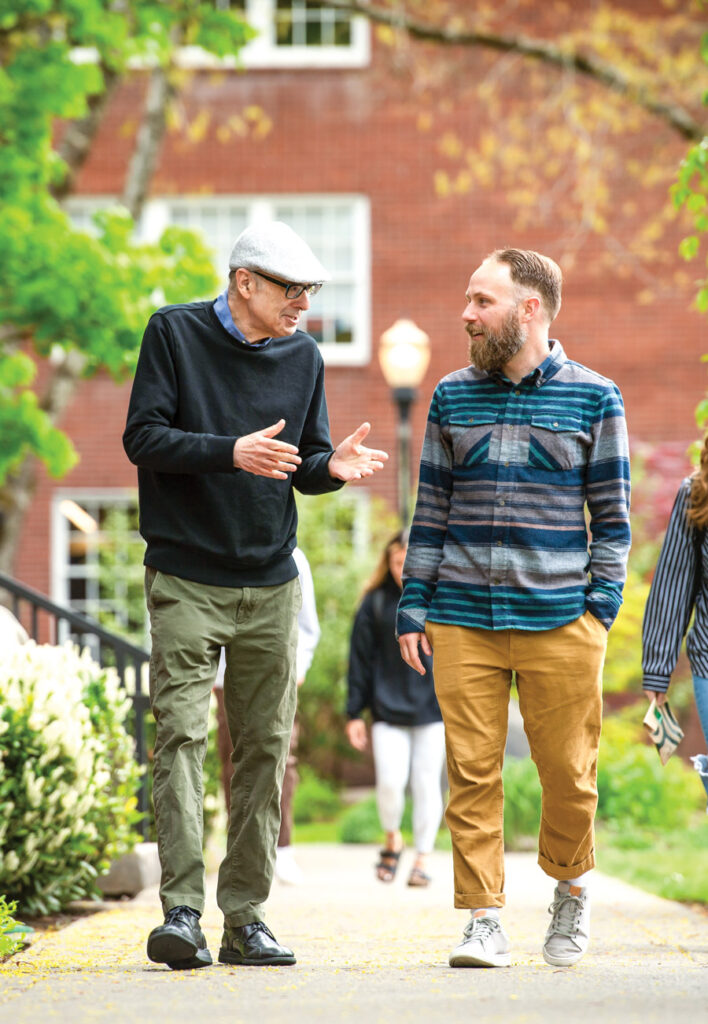
Richards and Young share a mutual respect and admiration for one another, evident during the conversation that took place in the spring for this article. They both say they’re committed to supporting students no matter where they fall on the faith scale.
The office’s underlying message: all are welcome here.
Q: Tell me a little about your background and what led you to Linfield?
J.R.: I was raised Conservative Baptist, and my dad was a high school science teacher, which posed an interesting tension. What he taught didn’t always coincide with the politics of the church. We were a devout household and committed to the faith, but we were also taught it’s okay to disagree, and it’s healthy to question some of the assumptions that were always there.
After completing seminary and becoming ordained, I did what I thought was the natural progression and went to work in the church. I knew I wanted to eventually work with college students, but I thought that meant as a professor; yet I felt called to a more pastoral role. And now, full circle, I get to do that at Linfield.
M.Y.: My grandparents and parents were Holocaust survivors. I was raised in an observant home, and I went to Hebrew school three days a week until my bar mitzvah at 13 years of age. In my professional life, I worked in California public schools for 36 years, and for 16 years I was a professional development consultant for The College Board.
In 2005, I was diagnosed with kidney cancer, and by June 2009, it had reached stage four. I came home and said to my wife, we need to be more conscious of what we want to do. And so, I made the decision then to retire and investigate rabbinical school. A trans-denominational school opened in Los Angeles; trans-denominational represents all Jewish denominations and movements, and that really appealed to me.
I enrolled in 2010, and I held my own with students who were half my age! It inspired me in so many ways and provided a lot more meaning, more purpose, a lot of connections, mentors, coaches, friends.
I taught Hebrew school for a while. And when I had the chance to interview with Jeremy for Linfield’s part-time rabbi position, I felt if this were to be the case, I would welcome the opportunity.
Q: What do you hope to accomplish through your work in the chaplain’s office?
M.Y.: This year has been about getting our footing. I’m here on campus two to three times a month, and we’ve mostly been out and about getting to know the students and raising awareness of the chaplain’s office. What we do this year I hope can be refined, improved as we move forward. We’ve planted the seeds, but we’re always receptive to other ideas and knowing the biorhythm of our students. Together, we are learning the students and how best to promote events.
J.R.: Linfield reflects the greater Pacific Northwest, which is largely not religious. For good reason, people have hesitations around religion. I do want to stress that we’re about spirituality and people finding their meaning. There’s some tension around religion, and assumptions about the kind of work this office is doing. We have to work to overcome this, and I want our students to know that they don’t have to identify with or belong to a specific faith in order to seek our support or attend our events. At the same time, we understand that there are actually quite a few students who belong to a specific faith. We want them to feel valued and seen, and to grow in their particular tradition as well.
Q: On that subject, talk to me about your work with spiritual trauma.
J.R.: It’s something I am passionate about. At the core of my understanding, the divine is love. So, I just want to help students feel loved and accepted. My work at my last church focused on being more inclusive of the LGBTQ community. And so, speaking in terms of this community which has explicitly been traumatized by the church, it’s important that we find balance between students getting to know me and know that I’m safe; and also, I know I can’t just attend one of their meetings because my presence might be triggering for some. So, it’s a balance of being available without imposing. It’s just going to take time, I think, in building a reputation about the office and how we’re servicing students.
M.Y.: In my tradition of Judaism, we open doors. We’re accepting of all. Quoted in the Hebrew Bible many times is that you have to help the stranger, the orphan and the widow – so we never lose our connection to that.
Linfield really offers an optimal environment. I can empathize with the many bridges students have to cross and walls that they’re heading toward. Linfield students are in a prime territory for having personal conversations that they probably wouldn’t be able to have at a school with a student population of 30,000. Somehow, we’ve got to come together with those students who want to have these conversations.
Q. What sort of new traditions will this office establish?
M.Y.: Jeremy’s laid the groundwork. We both hold this value of learning from each other. In Judaism we have Tu Bishvat, or “New Year of the Trees,” celebrated mid-February, and Jeremy lined up a wonderful set of speakers from different religious backgrounds as well as an advocate for the environment. We integrate that with the fact that all of us, whatever denomination we represent, need to be stewards of Mother Earth.
He also brought in an excellent speaker for Ramadan. And for Passover Seder, we invite everyone to come and share common values or even areas where there may be some differences. You can never learn enough. That’s what we’re here for.
J.R.: For me, it’s less about setting “traditions” and more about creating a robust spiritual life at Linfield. I would love to see more engagement with the humanist side of it – students who don’t identify with a faith but feel called to contribute to the good and see their connection to other people. I hope to have a humanist student chaplain because, in reality, that’s probably where more of our students are. They care about meaning, vocation, etc. yet they don’t feel a divine connection. In the church, there’s this idea that if you don’t believe in God, you don’t have values. But we know that’s not true.
Q: Speaking of traditions, Baccalaureate returned this year after a hiatus. How did that go?
J.R.: This year’s event balanced formality with a celebratory feeling. We held it in Richard and Lucille Ice Auditorium to provide a more intimate gathering, and Linfield’s Concert Choir broke up the speeches with three upbeat songs.
Multiple faiths were represented during the service; there was a reading from the Hebrew Bible, the New Testament and the Quran. Three student speakers, one who is Buddhist and two unaffiliated with any particular faith, shared thoughts on their spiritual growth. Rabbi Mel and I both spoke, and our main address was given by Reverend Adam Ericksen ’02, currently the pastor of Clackamas United Church of Christ whose work is inclusive and justice oriented. All three Abrahamic faiths were incorporated into his address.
Q: What do you hope to inspire among the Linfield community?
M.Y.: To keep learning from one another. Look, listen, learn. Actually listen. Be present for our students and meet them where they are… in areas where they feel vulnerable or strong. Those are the conversations I look forward to when I’m here on a more regular basis.
J.R.: I want students to come here and grow in their own faith tradition, whatever that is, AND learn about other faiths. Inclusion is important to both of us. We celebrate all religious holidays when possible, or at least bring awareness to them. I’m happy to say that we have a part-time Muslim chaplain starting in the fall, too!


