
Athletes and trainers use science to improve athletic performance
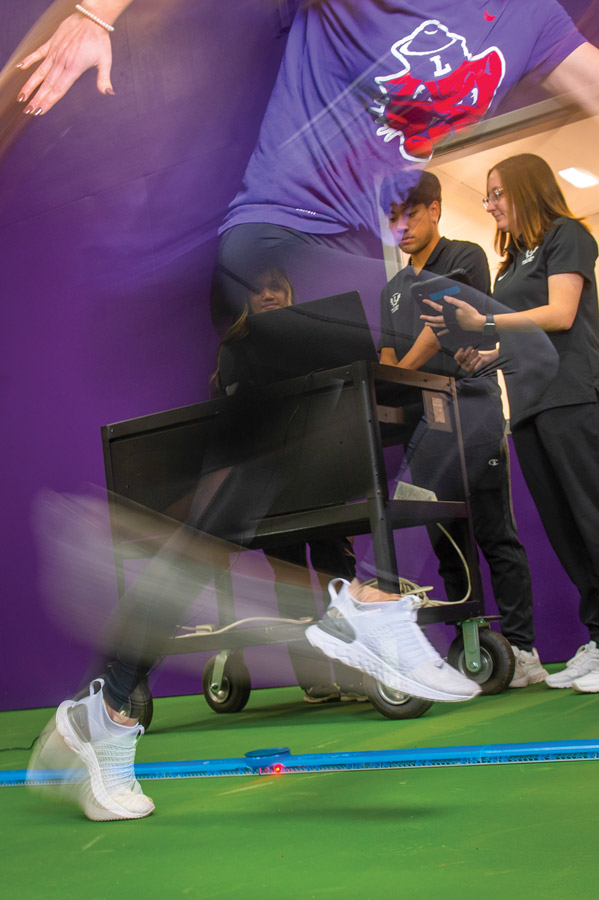
Of all the things that Associate Professor Cisco Reyes can measure in the new Wright Family Sports Science Laboratory and Classroom — whether an athlete is showing the earliest signs of injury, which part of the field a soccer player has the most speed in, how many moving objects a football player’s mind can track in peripheral vision — the simplest might be the most significant.
“There’s a direct correlation between your hand grip and how long you’re going to live,” he explained from the lab, inside the Rutschman Field House. “Researchers have said that when we see this benchmark of hand strength, we see people who live longer and can fight off diabetes, high cholesterol and heart disease. We haven’t seen anyone who has a strong grip that isn’t active, and we haven’t seen anyone who isn’t active that has a strong grip.”
This surprising data point speaks to the often-misunderstood work of sports science, which uses technology to precisely assess the amount of stress a given human body needs to walk the fine line between improving performance and preventing fatigue and injury.
“Everyone has different genetics, and every athlete — every body — is different,” Reyes said.
Using GPS units, precise laser sensors, a force plate that measures the nature and in-air movement of a jump and an enormous screen that tests everything from reaction time to spatial memory, Reyes and graduate students in the sports science and analytics program assess athletes on a level impossible via human perception alone.
In turn, the graduate students share that information with coaches and trainers, who can then provide personalized feedback to athletes, telling each player whether they need a particular kind of strength conditioning, to work on increased flexibility or simply that they’re reaching a point of fatigue and need more sleep.
“You watch someone do a jump and to the naked eye, the entire basketball team is jumping more or less the same,” Reyes said. “But the force plate measures the body’s sequencing — are they using momentum to jump, or are they using pure force? Are they able to extend their hips for the full range of motion?
“Then, the coach can say, ‘OK, you five — you’re doing heavy strength training. And you five, you’re not going to lift as heavy; you’re going to train your body to move fast.’”
The Wright Family Sports Science Laboratory and Classroom slowly opened throughout the fall of 2022 as equipment arrived and students were trained on how to use each piece. The lab provides tremendous benefits to the 40% of Linfield undergraduate students who compete in intercollegiate athletics, giving them access to equipment (and data for their coaches) rare at the NCAA Division III level. It also provides students pursuing their Master of Science in sports science and analytics an endless supply of subjects for their graduate-level research projects.
Take, for example, women’s soccer players, whose practices and games have produced tens of thousands of data points for second-year graduate student Kyla Alvarenga-Beech ’18, ’22.
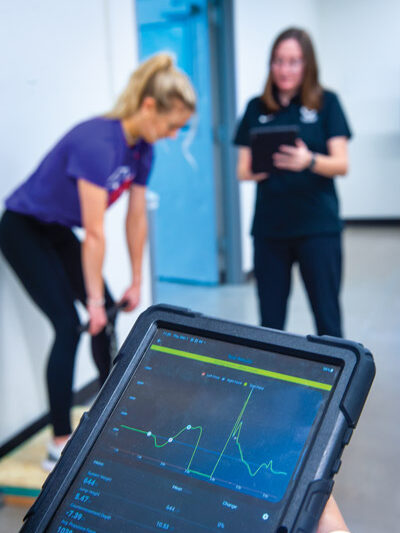
Alvarenga-Beech tracks the players’ individual movements with 30 GPS units, each of which is tucked in a sports bra-like vest at the beginning of a practice or game. She then sorts through that enormous data set to find the stories the players’ bodies are telling.
“I find that some players are doing double or triple the load of other players and that’s where I’ve been able to help Coach Steve Simmons a little bit,” she said. “He knows how individual players are playing. For instance, in the second half of the season, you have to be really cognizant because they’ve been playing for months and this is when injuries and fatigue can occur.”
While this technology is not unique in the state — Reyes said that it is being used by Nike and the University of Oregon — its availability to both graduate students and Division III student-athletes is singular on the West Coast, and perhaps even the country.
“Our student-athletes — boy, do they ever benefit from this,” said Athletic Director Garry Killgore. “Division I schools that have a lot of money have this technology, but schools our size traditionally don’t.”
It’s a reversal of the stereotypical tension between academics and athletics at many higher education institutions.
“This is such a perfect union of academics and athletics. It not only epitomizes what we want in scholar-athletes, but it also solidifies the long relationship between athletics and the studies pursued in the Department of Health, Human Performance and Athletics,” Killgore said.
“It’s part of the Linfield ethos and history of experiential learning,” said Jeff McNamee, chair of the Department of Health, Human Performance and Athletics (HHPA). “And it fits perfectly within the rich history of athletics at Linfield.”
Though it may seem a natural marriage, the Wright Family Sports Science Laboratory and Classroom would never have come to fruition were it not for Killgore. He first conceived of the lab and program of study when he arrived and brought what was then known as biomechanics to Linfield in 1989.
“There were no dedicated labs, no pieces of equipment — nothing,” he said. “Piece by piece, we were working to make exercise science flourish.”
His resolve strengthened in the 2000s, when he traveled through Europe, working with some of the most elite athletes in the world — Manchester United, Chelsea Football Club, the English Rugby Union, Real Madrid and more.
He saw how European sports scientists were far outpacing their American counterparts when it came to harnessing technology in sports and was determined to make Linfield a center of change.
The change was, to put it mildly, a long time coming — Killgore remembers scheming about it decades ago as a professor with former colleague, professor and cross country/track and field coach George Oja.
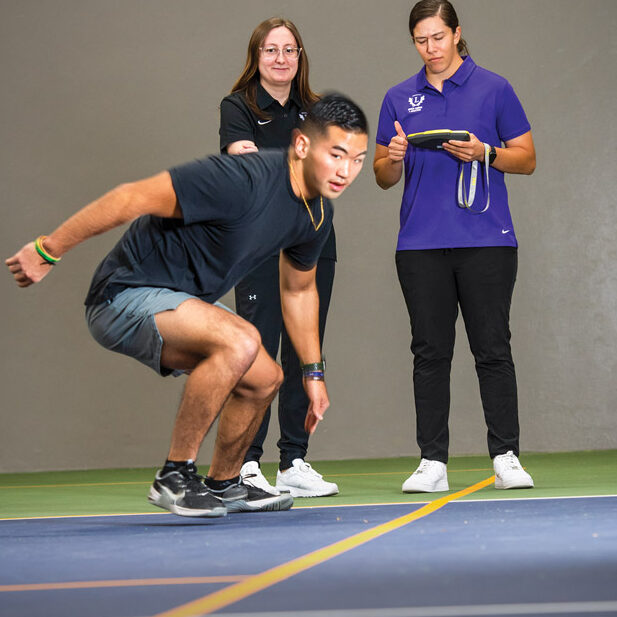
“We talked about using that part of the field house 30 years ago, and again about 15 years ago. But there were different administrators at the time and, ironically, I couldn’t make this happen when I was a professor, but I could as athletic director,” Killgore said. “All the pieces of the puzzle could coalesce — a great sports sciences program that relies on the academic side to gather and analyze data, and then interpretation of that data for our coaches and athletic trainers … to increase athletic performance and decrease the likelihood of injury.”
As he was making the transition from professor to athletic director in 2017, Killgore reached out to Reyes to help him develop the master’s program in sports science and analytics.
“Garry called me and said, ‘I have a vision, I have a plan and I want you to be part of it. Are you in?’” Reyes said. “And I was.”
Beyond Linfield student-athletes, both Reyes and Killgore envision the lab as a resource to all Linfield students, local schools and the McMinnville community.
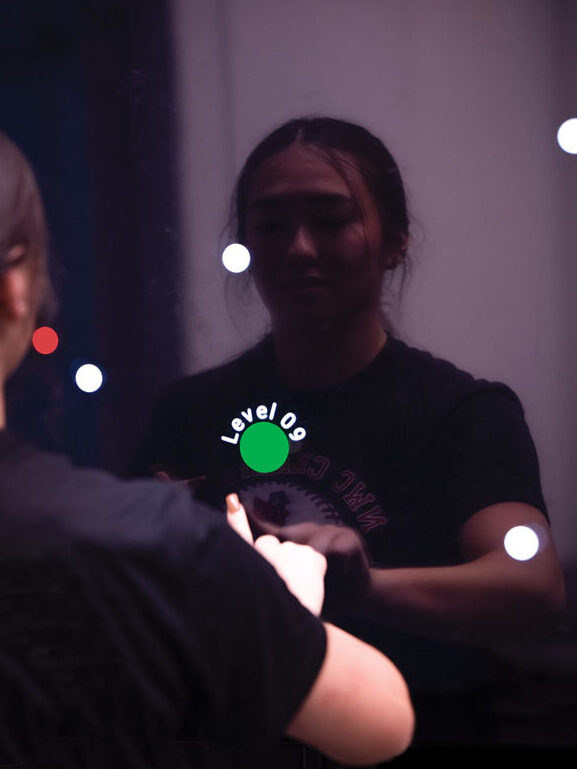
“Everything we have here is meant to be open to our community, whether that’s McMinnville High School or Linfield as a community. This can give them a sense of where they are, and how to get where they want to be,” Reyes said.
“Our colleagues in math and computer science and the School of Business, they can’t wait to collaborate with Cisco,” McNamee said. “They’re all finding opportunities for shared experience with this stuff, and it’s amazing to see how it resonates beyond the lab with students. They’ll be in computer science and be like, ‘Oh! We just learned this in Cisco’s class!’ That’s when the light goes on. And that’s not just this lab — that’s Linfield, in general.”
What’s in there?
Much of the Wright Family Sports Science Laboratory’s equipment is deceptively simple looking.


