
A partnership with a manufacturer gives nursing students access to state-of-the-art equipment
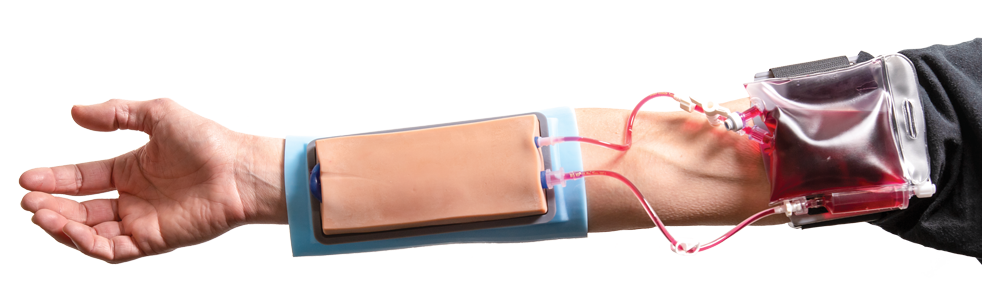
Intubating a patient with a blocked airway, inserting a port line in a chest and bandaging an open wound – nursing students rely on simulation-based learning to practice skills such as these in a safe learning environment. The types of models used are just as varied as the range of skills practiced: Full-body manikins that provide feedback on treatment; rectangular tissue pads to practice sutures through layers of skin; or a plastic arm complete with a pulse for taking blood pressure measurements.
Thanks to a partnership with the manufacturing company VATA Inc., students at the Linfield-Good Samaritan School of Nursing are getting their hands on a new specialized task trainer before it even hits the market.
“We reached out to a couple schools, like Linfield, and hospitals with simulation centers to see if anyone would have interest testing out one of our new prototypes,” said Andrew Call, president of the Canby-based company.
We need people using them, trying them out and providing feedback on how to make them more useful.”
– Andrew Call, president, VATA Inc.
The prototype currently being tested is a wearable sleeve-like device. Silicone skin covers IV tubing full of simulated blood, which students use to practice venipuncture, the collection of blood from a vein. These sleeves can be worn by manikins or “standardized patients,” actors who provide immediate feedback to students. Call expects these particular trainers to sell for around $200-250 apiece.
Companies like VATA sell simulation equipment to schools, hospitals, military organizations and health care research companies for skills training and development. The global medical simulation market is a fast-growing industry, estimated at $1.9 billion in 2021 by Grand View Research. A continued emphasis on patient safety and increases in technology are expected to help revenues in the segment grow to $5.48 billion by 2028. It’s a competitive industry, making pre-market consumer feedback all the more valuable.
Linfield students also benefit from the partnership by developing greater insights into the product development process, Call said. Students experience the rounds of prototyping and testing before Linfield receives the final product, usually free or at a substantial discount.
Initial feedback from Linfield’s testing site included adding more skin-tone options, varying levels of difficulty and differing arm sizes to account for a variety of body types.
After making adjustments, VATA provided a revised prototype to their testing sites to get a final round of user feedback.
“On the first prototype, the skin was thin, which made it too easy for the nurses to find the vein,” said Amanda Bergman, Linfield’s new Experiential Learning Center manager. “This new model is much better and much more realistic than other task trainers that we have.”
More than 80 traditional BSN and accelerated BSN students had the opportunity to test and provide feedback on the prototype, Bergman said.
It’s an experience that’s a win for all those involved: VATA produces a well-tested product, students learn on the latest training equipment before it hits the market and Linfield receives products for continued simulation learning.
After incorporating final feedback from Linfield’s beta testers, as well as from other test sites, McCall expects the product to hit the market (and Linfield’s Experiential Learning Center) in spring 2023.


