
Archive coordinator explores the history of Linfield students on and off the dance floor
Thanks to Linfield’s origins as a Baptist-founded school with curriculum and campus life focused on Christian teachings, dancing was forbidden on campus for the first 88 years of the school’s existence. Seen as a dangerous act that could lead to immorality and depravity, dance was strictly excluded from campus functions. From homecoming festivities to Sadie Hawkins Day and the all-important May Day celebration, students participated in many regular school entertainments, none of which included dancing. Instead, school “formals” were centered on a musical or dramatic performance rather than dancing.
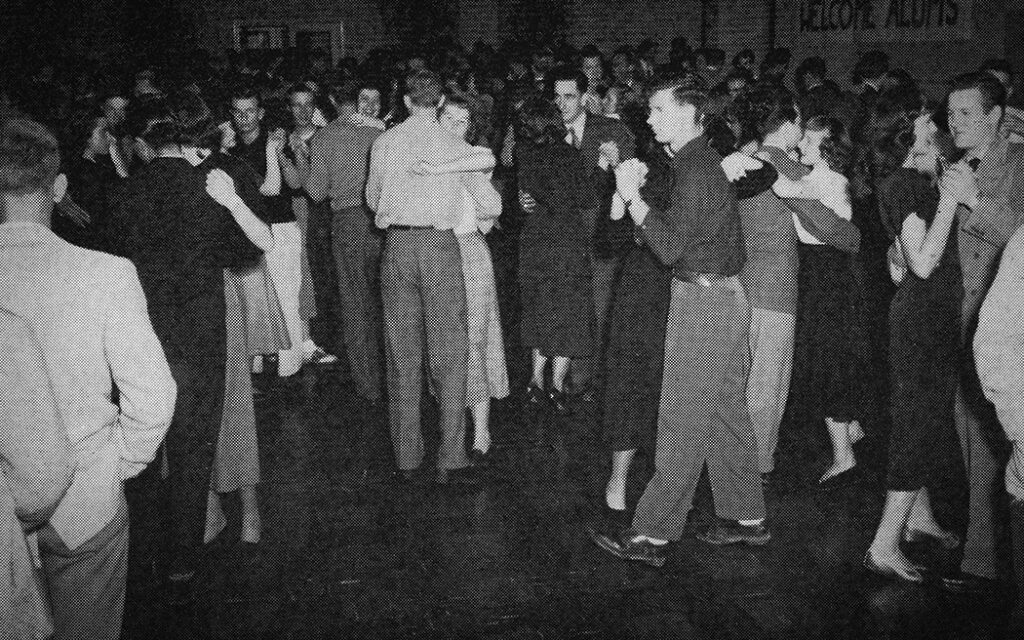
In 1936, a group of students petitioned for dancing to be allowed at Linfield, only to be met with staunch presidential and trustee resistance that persisted for another ten years. However, 1946 saw the return to campus of World War II veterans, many with their wives and children, along with a first-year class of 432 students, which was the largest to date and would remain so for several decades. These student body changes helped push past the administrative resistance to usher in the era of dance at the Linfield campus. Surprisingly, despite its long-delayed arrival, such a momentous change was greeted with little fanfare. The first-ever, school-wide, on-campus dance was held on November 5, 1946, with an autumnal theme and an almost-capacity crowd of students.
Despite the dire warnings against the pitfalls of dancing, once the ban was lifted in 1946, dances were quietly (and, for the most part, wholesomely) inserted into the campus schedule and quickly became common features that would last for many decades. Different campus groups, such as the Association of Women Students and the Intercollegiate Knights, were frequent sponsors of school-wide dances, as were individual classes, which organized events like the senior “Rainbow Reverie” in 1948 and the sophomore “Emerald Erie” in 1949. Dances were quickly folded into the normal rhythm of campus life.
Eventually, these rhythms changed. Different student needs and expectations gradually decreased to almost nonexistence the popularity of formal dances on college campuses. As it turns out, one generation’s emotionally-charged debate is now a sidebar to the next generation’s story.
A time to dance
The students who first met with President Elam Anderson in 1936, according to the history recorded in the book “Inspired Pragmatism,” wanted a summary of their discussion to be published in the student newspaper. The president would not allow it but did send the summary to the trustees. Author and Linfield trustee Marvin Henberg outlined some of the arguments both for and against dancing at the time.
Arguments against:
Dancing involves sex stimulation – a stimulation that often leads to prostitution.
The stuffiness of the dance hall and of perspiration is not sanitary.
Drinking is often associated with dancing.
Conducting a dance is a lazy way to entertain. Young people need to learn originality in entertainment.
It is not the place of a sincere Christian to dance; he has too many other more important things to do.
Arguments for:
The sex stimulation of the dance is not intense or harmful; as a matter of fact, a certain degree of it is desirable for wholesome sex development.
Dancing provides release of sex tensions and of restlessness; there is nothing better than exercise – and dancing is good exercise – for working off these natural tensions.
Drinking is not necessarily associated with dancing, and at Linfield College, students would learn to appreciate the desirability of dancing without drink.
The college is for education. People are bound to dance in any case; is it not better to provide college-conducted dances of a wholesome kind, so that students may learn to appreciate the better kind of conduct at a dance?


