
The Russian invasion of Ukraine may be happening 5,600 miles away, but for Anton Belov, the events hit close to home.
Belov, professor and chair of Linfield’s music department, spent his formative years in Russia and has deep family roots to Ukraine.
“My mother escaped from Ukraine only a few hours before the Nazi occupation,” he said. “I grew up with the memories of her escape and the pain of losing her hometown, a place which is now being bombed nonstop.”
A specialist in Russian lyric dictation, Belov is the author of multiple books and anthologies on Russian music. He also is the founder of RussianArtSong.com, a site devoted to the translation and dictation of Russian musical works.
But the noted Russian baritone refuses to be silent about current events. Now, he is using his voice to sing of Ukraine.
“I have made it my mission to promote Ukrainian repertoire and music as much as possible,” Belov said. “I’m taking a break from Russian. I’m not singing or teaching Russian until this is over.”
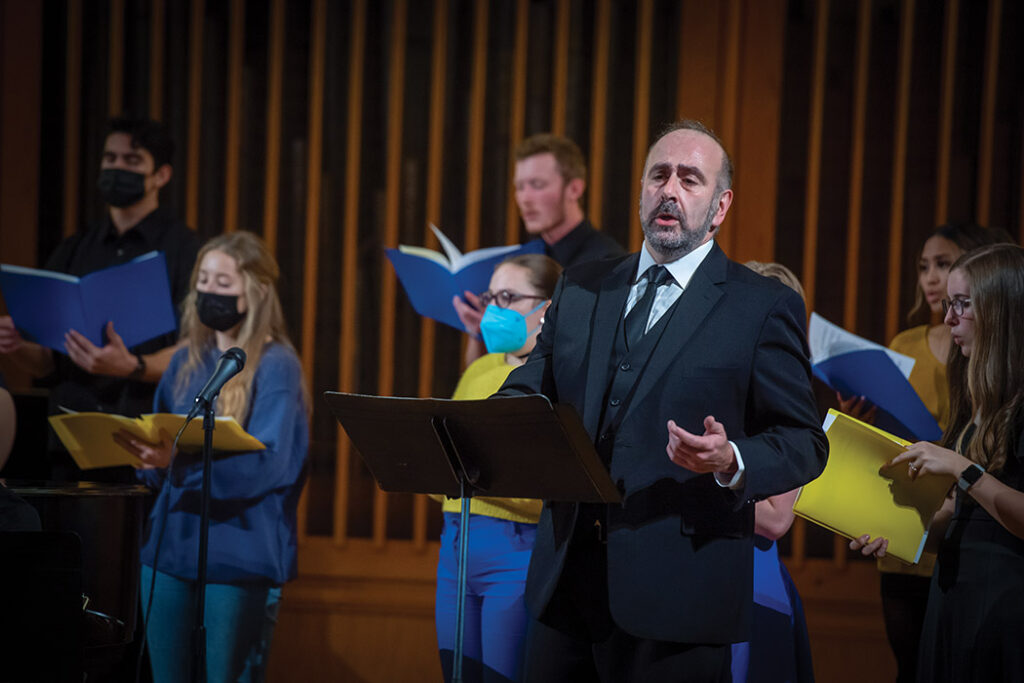
He performed in Ukrainian for the first time at a benefit concert at Linfield on March 17.
“Ukrainian and Russian are so similar, yet so different,” he said. “It’s like singing in Shakespearean English. Not a single sentence is performed the same.”
Since then, Belov has formed Musicians United for Ukraine to organize benefit performances of Ukrainian music throughout the United States. Since March, he has performed in eight concerts, raising around $40,000 for humanitarian aid. But for Belov, it’s about much more than the money.
“It is about the cultural recognition and heritage,” Belov said. “Language has been used as a weapon of domination for decades in Ukraine, particularly in eastern Ukraine. It was systematically organized that way to promote the Russian language as a symbol of upward mobility and education. Ukrainian was seen as provincial. Promoting Ukrainian music is one way to show the significance of the culture; that Ukrainian music is worth listening to and performing. And that is something that is more valuable than money.”


