
Holistic and student-led approaches increase safety on Linfield’s campuses
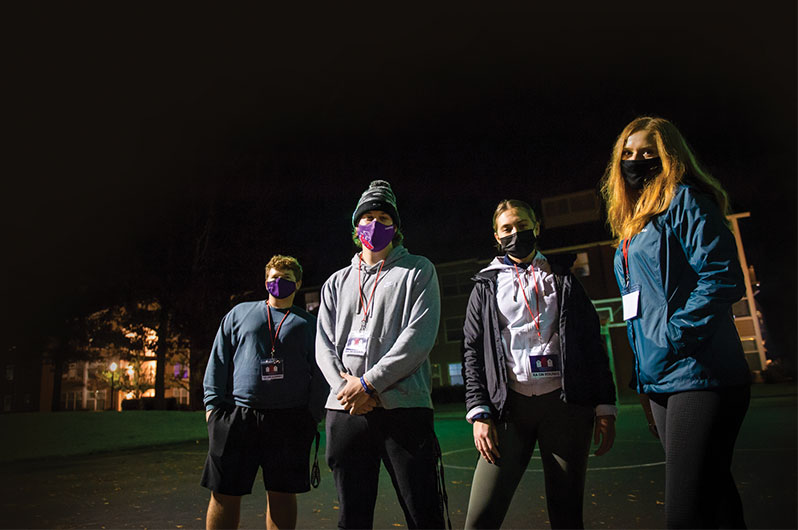
Call of duty: Resident advisors Samuel Dixon ’24, Evan Bates ’22, Carmel Wolff ’23 and Kelsey Jordan ’23 go on rounds throughout the south side of campus.It’s a quiet fall Friday night on the McMinnville campus. Small clusters of students walk back to residence halls after cheering on the Wildcat volleyball team, while others make their way to Starbucks to get a late-night caffeine fix.
At 9 p.m., four resident advisors (RAs) gather in the courtyard of the “six pack” – a group of residence halls located between Dillin Hall and the softball stadium. The RAs are heading out on the first of four rounds of safety checks they will do overnight. Their route takes them onto every floor of 10 buildings located on the south side of campus.
“We certainly get our 10,000 steps in on these weekends!” says Kelsey Jordan ’23, majoring in exercise science and an RA in the Hewlett-Packard Apartments.
A national survey from the Clery Center found that 82% of college students this year are concerned about their personal safety, and 97% said they consider their safety in their everyday decisions. The Clery Act, Title IX and other related federal legislation protect students on campuses across the nation. But, protecting students physically, as well as emotionally, so they can thrive in and beyond their college career has many layers. And it takes all members of the campus community to foster a culture of safety, support and mutual respect; often referred to as a whole-school approach (WSA).
Studies show that safety improves when the student population engages in these efforts. Sarah McMahon, director of Rutgers’ Center on Violence Against Women and Children, found in a 2019 study: “Other fields using a WSA have placed students at its core, recognizing that they are not only the recipients of programs and services but should be engaged as partners and critical contributors. Those programs that include students in engaged ways may have better outcomes.”
In addition to planning social events and connecting residents with campus resources, Linfield’s 55 RAs, four residence life assistants and three area directors also respond to a variety of safety concerns. Each RA completes three weeks of training at the beginning of each year, which ends with three days of intensive workshops on responding to varying levels of incidents – from navigating roommate conflicts to relationship violence.
“We actually don’t field a lot of conduct issues,” said Kathleen Jenson, assistant director for residence life and one of the coordinators of the RA training. “We provide a lot of care.”
RAs are just one group of students who take an active role in campus safety at Linfield. The Associated Students of Linfield University’s (ASLU) safety focus group is another. In 2021, this group worked with Linfield Public Safety (LPS) to launch Wildcat Guardian, a location-based emergency safety app that quickly connects students on either campus directly with on-duty LPS officers or the local police anytime, anywhere – even if not connected to Wi-Fi.
This year, ASLU and LPS are piloting a Student Safety Patrol to complement the work of Linfield RAs. While RAs focus inside residence halls, safety patrol members will monitor the exterior areas of campus and offer safe walks to McMinnville students.
“Keeping our students safe, physically and emotionally, is always top-of-mind,” said Susan Hopp, vice president for student affairs. “I’m really proud of the collaborative approach our campus communities take each and every year to ensure the safety of our students.”
The RAs find a strong sense of purpose in their roles building relationships and trust with their peers and creating connections across campus.
“We’re not here to bust anyone,” Evan Bates ’22, a senior majoring in sport management and an RA in Terrell Hall, said of the patrols. “We’re here to help should they find themselves in a position where they need it.”
Increasing safety on two campuses
University-wide improvements:
- Sexual Assault Taskforce established May 2020 to evaluate Linfield’s Title IX policies and procedures.
- Title IX Working Group established Sept. 2020 to take action on the taskforce recommendations.
- Wildcat Guardian app introduced Aug. 2021, replacing Linfield’s outdated blue light callboxes.
- A new student care and support director hired July 2021 to support students through mental health, academic, social and school-life balance challenges.
- Kelsey Murray hired in Sept. 2021 as coordinator of student wellness and survivor advocacy.
McMinnville campus initiatives:
- New room doors with peepholes installed in residence halls.
- Project to improve exterior campus lighting continues. Started in 2017, the current phase includes working with the city to improve lighting on city-owned streets on campus.
- Dennis Marks, director of LPS, secured a Department of Homeland Security grant to help fund a new security camera and surveillance system which includes 29 additional cameras. Installation to be complete by March 2022.
Portland campus initiatives:
- Motion lights installed in new classroom and experiential learning center spaces.
- Addition of ID swipe access control system at one exterior door per building.
- New network of 30 interior and exterior security and surveillance cameras installed.
- New permanent fence with automated gates installed along the west perimeter of campus.
Read the latest safety initiatives and support resources.


