 I was about 16, returning from a two-month summer field trip with my father to Wyoming’s Big Horn Basin. A colleague of his from the Field Museum was there, too, with his son, Dave. We stopped in Spearfish, S.D., where a third paleontologist, John Clark (“Mighty Hunter” to us), had been excavating a pterodactyl. Dave and I were helping Dr. Clark encase that proto-bird in plaster for shipment back to the museum. Mighty Hunter had been a spy in China during World War II, and he stayed in Asia after the war to explore kingdoms in the Himalayas.
We were in awe of his learning, his Chinese, his field research – the whole package. He turned to us in that sweltering heat and asked, “What are we doing here?” I’m sure that Dave and I had the same answer in mind: “Well, we’re dying of thirst and want to drive into Spearfish for an orange milkshake.” Then he answered his own question with another: “Aren’t we all trying to find the origin of the universe?”
We didn’t say that he had taken the words right out of our mouths. I am sure, though, that Dave has not forgotten that moment, the sort that illuminates perspective, insight, perhaps even destiny.
I don’t write about that moment in course syllabi, but I do try to keep my students focused on larger questions about their own search for whatever internal and external universe will keep them fascinated and humming for the balance of their years after Linfield.
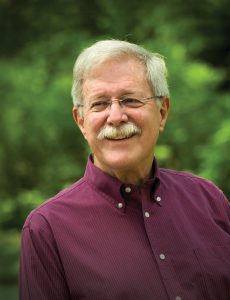
– Peter Richardson, Professor of German
B.A. Stanford University
M.A. Ohio State University
M.Phil., Ph.D. Yale University
Academic Interests: Language pedagogy, linguistics, Latin, folklore, German literature, American English
- 2009 Oregon Professor of the Year
- Edith Green Distinguished Professor Award,
1987-88 and 2008-09 - Colloquium advisor since 1987
- Member of the Linfield faculty since 1980
- Author of Unser Wohnort ist ein wilder Berg (The Place Where We Live is a Wild Mountain), a collection of Swiss transcriptions, the oldest of which dates to 1560.


