
By Kevin Curry ’92
Like something out of “CSI,” Linfield scientists are digging deep into the mysteries of decomposition.
Their painstaking study of an animal’s body may fill a critical information gap for the state crime lab — and help solve missing-person cases.
Day 1: Dec. 8, 2019
A pickup carefully navigates the path to Cozine Creek. The pig in its bed was once destined to spend its life as a 4-H project. A fatal illness means its body will now contribute to science.
Linfield students and their instructor place the pig in a wire cage, take photos and set up a trail camera, preparing to collect data on the pig’s decomposition over the next four months.
Elizabeth DeVisser ’04 is an expert in how human bodies decompose. As Linfield’s anatomy and physiology lab coordinator, she’s always looking for ways to bring science into the real world. When Dr. Nici Vance, a forensic anthropologist with the Oregon State Police, told DeVisser that the state lacks data on how tissue decomposes in Oregon’s varied climates, DeVisser knew what to do: Put out a pig carcass and have students track its progress.
An interesting science experiment for her students — and valuable data for the police.
Researchers generally use pig cadavers in place of human remains. DeVisser’s first Linfield pig study took place the spring of 2019. She wants the research to continue each season because comparing data from different time periods can help solve missing-person cases.
“When we find a person, based on our previous studies we can say ‘They’ve been here this length of time,’ and we’ve narrowed down the possible identification,” she says.
Day 43: Jan. 20, 2020
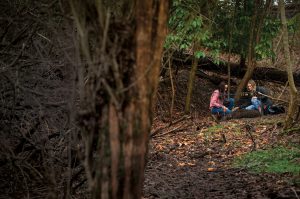
It’s mild, overcast but no rain. Biology majors Francesca Sheld ’21 and Taylor Vogel ’20 turn off the path toward a remote part of the creek. It’s a process the two repeat several times a week, along with Grace Thompson-Johnston ’20.
Vogel records data on a laptop: high and low temperature, humidity, weather. She uploads images from the trail camera. They show deer in the distance and squirrels crawling into the pig’s cage.
Sheld opens the cage and snaps more photos. “We have some activity going on in his upper armpit area,” she notes. “There’s a lot of skin slippage and some decomp going on.”
Cold weather slows decomposition. Maggots and insects have yet to begin their important work.
The stages of decomposition do not change, but factors like temperature, humidity and barometric pressure can drastically change the rate at which a body breaks down. Each affects how fast insects consume the remains.
Last spring, students collected data similar to Vogel’s and inspected insects from their pig for identification.
Scientists can use insect activity to estimate time of death, but they need detailed information about how tissue breaks down in different environments.
 |
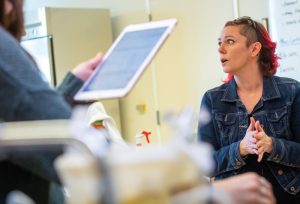 |
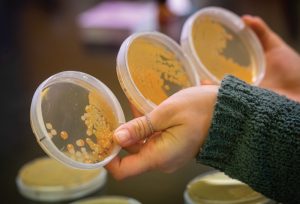
| Instructor Elizabeth DeVisser ‘04 launched the decomposition research project after talking to the forensic anthropologist for the Oregon State Police. Inspired by what they learned in another course, her students are also examining bacteria they found growing on the pig’s body. | |
DeVisser says there are no published studies of this kind for Oregon, and research is needed statewide. “We’ve got the coastal climate, we have this Yamhill-Willamette Valley area, and then we have Eastern Oregon,” she says. “You can’t just use the same reference data for all.”
Vance sees working with universities as the best way for law enforcement officials to develop the decomposition data needed to solve their cases.
“The students of these research projects will be fascinated by the results, which will hopefully motivate them to dig deeper into relationships between our specific climate and decomp rates,” she says. Professors and students provide the expertise and resources to collect the information, and “our entire forensic community will benefit.”
Day 54: Jan. 31, 2020
“He smells,” Vogel says.
“Ooh, yeah, he’s quite pungent,” Sheld replies, unlocking the cage.
Vogel notes skin slippage on his abdomen and something orange growing there.
“I’m wondering if it’s some kind of bacteria,” Sheld says. “I kind of want to culture it.”
She remembers a microbiology assignment in which her class cultured an unknown substance to identify the organisms in it.
An idea is forming.
DeVisser likes the idea. “Within the last couple of years, people have started to do microbiome research on decomposing remains,” she says. Knowing the microbiology of a particular bacteria provides additional data for estimating the decomposition rate, ultimately increasing the chances for human identification.
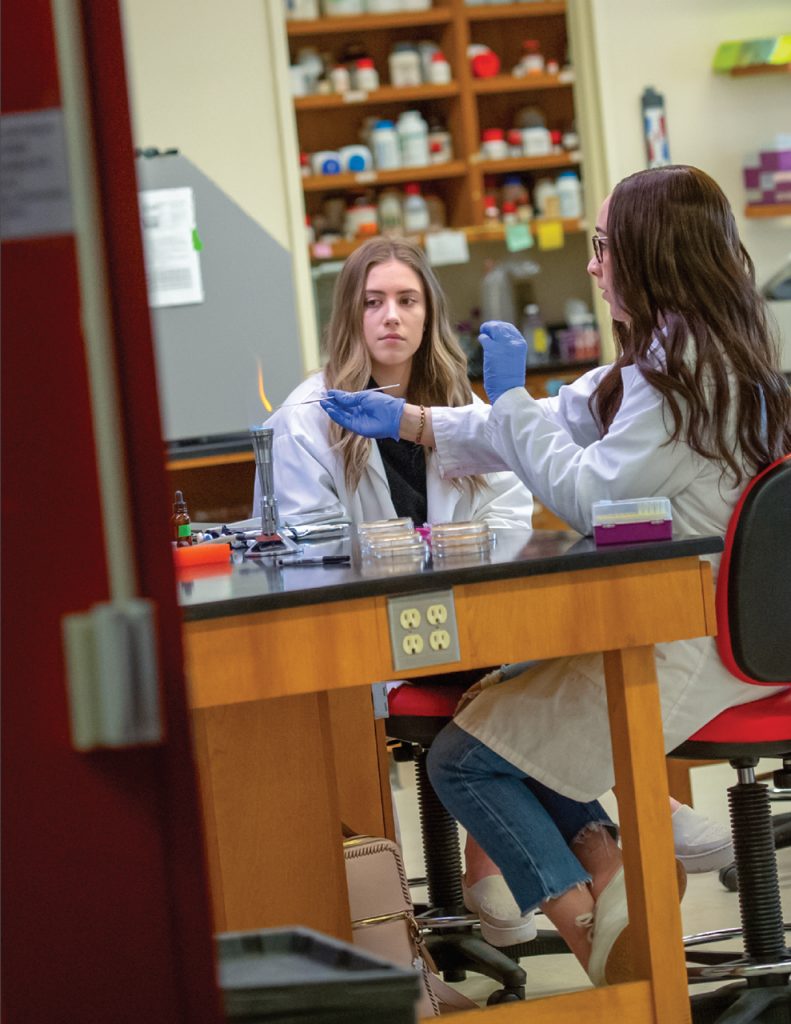
At a later visit, the students swab the pig for samples of the orange film to examine in the lab. With the help of biology professor Jeremy Weisz, the decomposition study has also become a microbiology research project.
Day 94: March 10, 2020
“He’s not exploding yet,” Vogel says. “Which is what we are waiting for.”
Stomach bloat makes the pig’s skin tight, like a balloon nearing capacity.
“The majority of the inside has already decayed because of the bacteria in the gut,” Thompson-Johnston says. “Once it bursts it has more surface area for insect life.”
Flesh has fallen off the pig’s back and legs. Maggots congregate on his neck and more bugs fly around.
The warming spring is beginning to do its work.


