
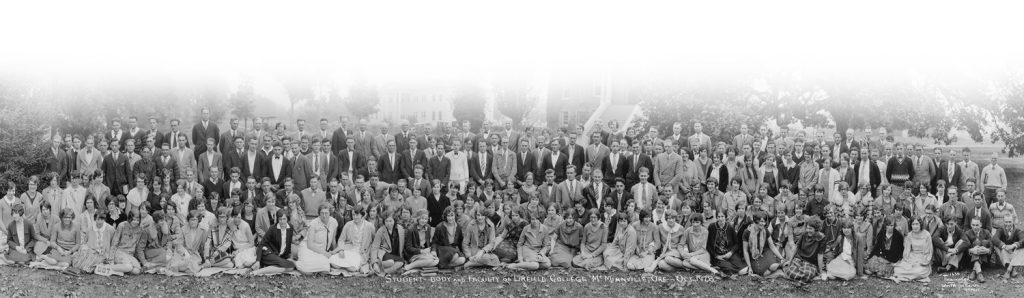
 Linfield’s enterprising spirit has always kept the college going — even when success seemed improbable at best.
By Rich Schmidt
Let’s start with this: Linfield shouldn’t be here.
There’s a lot to unpack from that kind of declarative statement. So let’s go back to the beginning.
One of the many byproducts of the Oregon Trail was an educational gold rush in the West. Every religious organization wanted to establish higher education in the Oregon Territory. It was estimated that roughly two in 10 of the schools created here in the mid-1800s survived into the next century, leading Oregon to be dubbed a “college graveyard.”
The American (Northern) Baptists were one of the groups seeking a foothold in the region. In the 1840s they set up a college in Oregon City that fizzled after a short time. Undeterred, they surveyed a number of sites in the Willamette Valley, settling on McMinnville for the simplest and perhaps silliest of reasons: There was a building here that could conceivably host a college.
Roller coaster early years
McMinnville in 1858 was a tiny village of a few hundred farmers, but that didn’t deter the college from lofty ambitions. It offered a classical education with freshman-year classes on Caesar and Cicero and Xenophon’s Anabasis. It shouldn’t come as a big surprise, then, that the school didn’t produce a college graduate until 1884.
For the first half-century of its existence, Linfield was a secondary boarding school that occasionally graduated college students. It served the needs of its time, offering basic education to a mostly local population, focusing on educating future teachers and adding a music conservatory to meet the wishes of its students.
At least, that’s the optimistic version of what was happening between 1858 and 1906. If you’re picturing a typical institution, slowly growing on a steady line, change that mental image to one of a roller coaster. The institution never had financial security. School years started late because presidents and professors were hired and didn’t show up. Students withdrew from school to help with busy season on farms. Staff were occasionally paid with IOUs.
The school was almost completely reliant upon the skills of its president. When strong leaders were hired, funds were raised and the student population crept up. But presidents of the time rarely stayed more than a few years, and the next president might quickly undo all that progress. Or an illness outbreak or global recession might thwart a fundraising trip. Could Portland be the answer?
Each time the institution was threatened, the school’s board of trustees raised the same solution: Let’s close the school and move it to Portland. This was seen as the end of the rainbow: Portland, where there was infrastructure, money and people. At least a half-dozen times in the first 50 years, this nearly came to pass. It seemed an inevitability that, at some point, the school would cease to be in McMinnville. Or just cease to be.
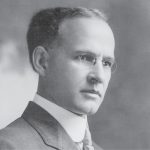 The last — and most dire — of those close calls happened in 1905. The school was days away from shutting its doors. The board wanted to move to Portland, but the finances were so dire that the school may never have reopened.
In a last-ditch effort that was equal parts brilliance and good luck, the board hired Leonard Riley as the school’s new president. In the next 25 years, he led the school from the brink of closing into its new era. Among his many accomplishments: securing money to build Melrose Hall and add or expand other campus buildings, bringing the curriculum up to what we would now consider accredited standards, and of course securing a donation from Mrs. Frances Ross Linfield that changed the name of the school in 1922.
 Looking back, it’s clear the name change was more than cosmetic. The school had toiled for decades, scratching out a meager existence on the backs of hardworking people who refused to let it wither. The town of McMinnville played a sizeable role, too, helping prop up the college in its leanest times and recognizing the symbiotic relationship the town and gown had come to have. The Riley era, culminating in the two largest financial donations the school had ever seen, finally made Linfield feel like it belonged and might have a future.
Constantly changing
Still, it’s not a straight line. Linfield has been pushed close to the breaking point many times since. We’ve heard the stories. Of faculty and their families cleaning residence halls before the start of the school year to save on cleaning costs. Of budgets frozen, departments closed, positions eliminated.
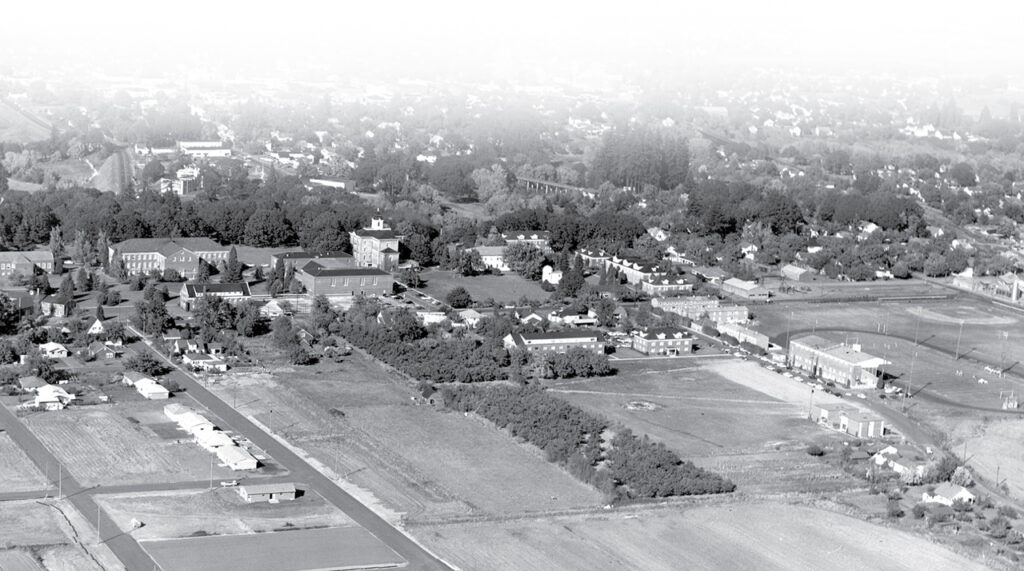 Throughout, Linfield has persevered. It has adjusted and weathered storms. Most of all, it has changed. It was founded as Baptist College at McMinnville, shortened later to McMinnville College, changed to Linfield College in 1922, and now has become Linfield University almost a century later.
The original campus was where McMinnville’s First Baptist Church now stands. Pioneer Hall was completed in 1883, marking the dawn of the new campus. The campus slowly grew at first, saw a population and building boom after World War II, then a near-doubling of campus size with the addition of the former Hewlett-Packard land in the 1990s. The nursing campus was added in the 1980s, in some strange way finally fulfilling the desire to move the school to Portland. That campus, too, is on the precipice of change with the purchase of a new home on the east side of Portland.
The curriculum has modernized — no longer do students have to learn about Tacitus and Euripedes (though they can if they so desire). Chapel is no longer required; residence halls are coed (and occasionally allow pets); the campus is not only no longer dry, but now has a wine sensory lab and a wine history archive.
Throughout, Linfield has changed to meet its present and future needs. More than many institutions, though, it has kept in touch with its past, with the struggles and perseverance of generations of Wildcats who have come before. With the fantastic odds that have been overcome. Linfield shouldn’t be here. But it is. And now it embarks on its newest era, as Linfield University.
Rich Schmidt is the director of archives at Linfield.


