
Linfield students help save the northwestern pond turtle
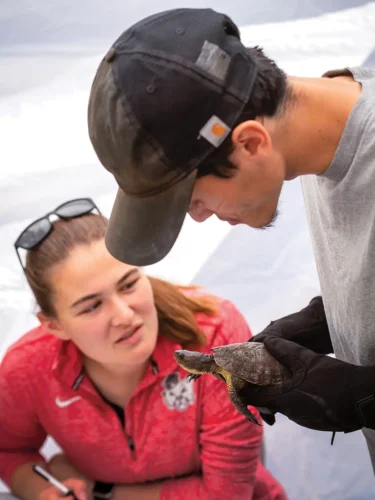
Kai Szostak ’25 carefully removes a small turtle from a hoop trap and hands it to Becks Mifflin ’24, who quickly uses digital calipers to measure the length and width of its shell. After noting the measurements, they put the small reptile down and reach for another. It’s a scene that repeats throughout the day at the Muddy Valley Habitat Reserve – a 540-acre wet prairie and oak woodland located southwest of McMinnville. It’s not the expected setting for a class, but on this day, students from Linfield University’s environmental studies program are living out a conservation story unfolding in real time. In partnership with the Oregon Department of Fish and Wildlife (ODFW) and the Yamhill Soil and Water Conservation District (YSWCD), they are protecting the native northwestern pond turtle population. It’s a unique blend of classroom learning with environmental action.
“The northwestern pond turtle has seen population declines due wetland habitat loss, degradation of upland nesting areas by invasive plants, predation and competition from non-native wildlife, and fungal disease,” explains Kurt Ingeman, assistant professor of environmental studies. “On top of these existing threats, droughts have become longer and more severe across the turtles’ range due to climate change.”
In September 2023, the U.S. Fish and Wildlife Service (FWS) proposed listing the northwestern pond turtle as ‘threatened’ under the Endangered Species Act. Locally, FWS partnered with ODFW and YSWCD on a long-term project to monitor the turtle population in Yamhill County. Linfield students, as part of Ingeman’s senior capstone course, were invited to participate in this work.
“Our role was to collect turtles from hoop traps and to inspect, measure and mark them,” said Szostak, an environmental science major from Honolulu. “Collecting population counts and growth data can help assemble a clearer picture of the turtles’ current situation and aid in determining whether or not the species should have its status [as a threatened species] elevated.”
The data collected by Linfield students is used to establish priority habitats for protection, measure population demographic rates and estimate the response to conservation measures.
“Without [Linfield students’] help, we would have had much longer field days and a heavier workload on individuals. We greatly appreciate their help to engage with northwestern pond turtle monitoring.”
—Jordan Anderson, resource conservationist with the YSWCD
According to Anderson, the potential is high for continued partnership with Linfield’s environmental studies program.
“There is now an incredible dataset on the turtle population at Muddy Valley Habitat Reserve, and Linfield students could potentially conduct research and explore restoration projects to enhance the population,” Anderson said. “This research could also be used as part of the federal recovery plan for the species.”
Turtles aren’t the only ones who benefit from the project.
“Students get to trade the classroom for the field, applying their knowledge in practice and truly experiencing what it is like to be a natural resource professional,” Ingeman said.
The students agree.
“Our participation in this project has enabled me to gain a more comprehensive understanding of how mark-recapture sampling works,” Szostak said. “And, of course, it let me experience the process for myself.”
“It is wonderful to work on a conservation issue in action,” said Mifflin, an environmental studies major from Sherwood. “The excitement and energy I hold for these types of projects is proof of just how valuable this learning experience is.”


