
Nursing students pilot VR technology to enhance education
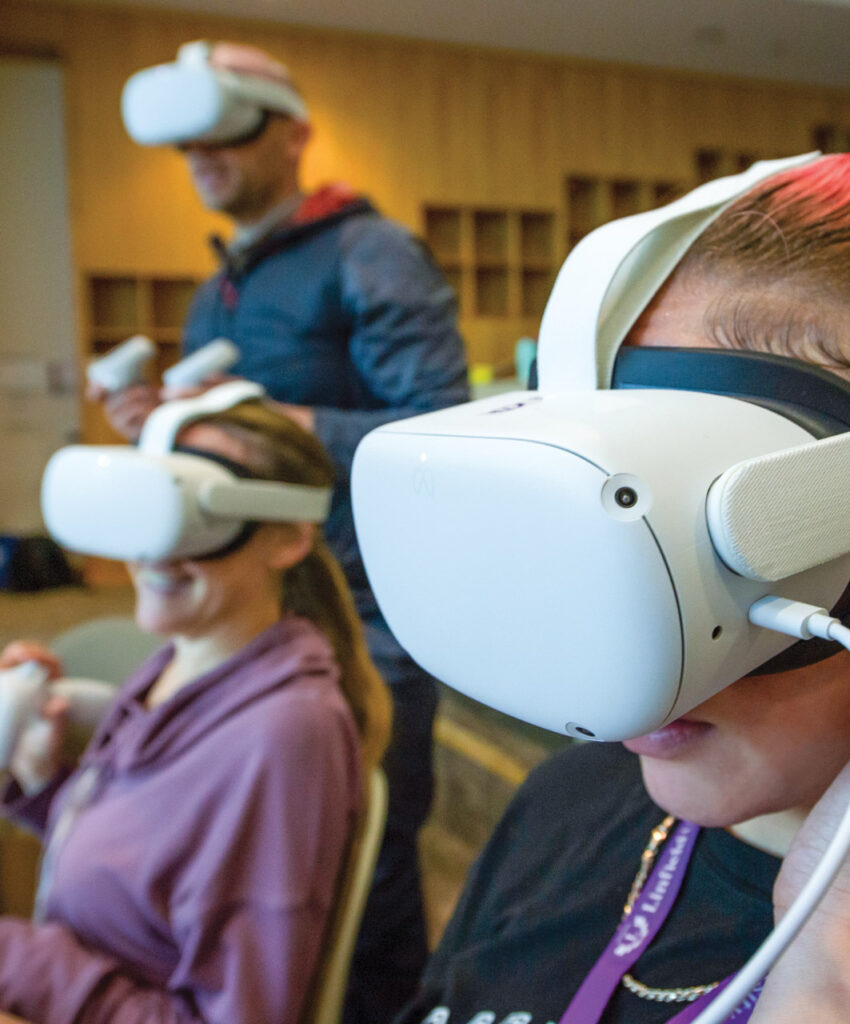
Twelve highly experienced nurses gathered together in a room, each with a different patient.
One searched through medical records on behalf of a man with chest pains. Another examined a young child whose chest was covered in bruises and avoided eye contact. Some consulted with their nurse’s assistant, others phoned the doctor on call, started an IV or ordered further tests.
These nurses – all Linfield University-Good Samaritan School of Nursing faculty members – were trying Oxford Medical Simulation’s (OMS) immersive virtual reality program for the first time, and they were impressed. As they slipped the Oculus headsets on, people gasped.
“I was amazed. At one point, I was about to lean on the table before I remembered it wasn’t actually there,” said Ingrid Flanders, an assistant professor of nursing who specializes in family nursing. “I went to exit a room and my patient scolded me — ‘You’re done already?’”
At Linfield, Associate Dean Julie Fitzwater was the first to spot VR on the horizon. About five years ago, she experienced a demonstration of the technology at another Portland nursing school.
At the time, she said laughing, “it wasn’t the cute little Oculus goggles. It was a huge pack and big helmet.”
Even then, she said, it was clear the technology had enormous potential even though it was in its infancy. And much like artificial intelligence, it has come a long way in the last five years.
Investing in VR
Under the leadership of Dean Paul Smith, the School of Nursing invested donations from One Wild Day, Linfield’s annual giving day campaign, to explore how these virtual patient scenarios could profoundly alter the way the university teaches nursing. Starting in the fall, members of the Master’s Entry into Professional Nursing (MEPN) cohort will participate in a pilot program using the technology.
After slipping on the headset, a user is immersed in one of more than 200 scenarios that includes pediatrics, maternal health, primary care, nursing emergencies and mental health, among others. People might find themselves in a hospital emergency room, a birthing suite or a family doctor’s office.
Everything around the room – the patient, equipment and medical personnel – replicates reality. Haptic feedback, similar to a gentle cell phone vibration, alerts the user to an interactive object or person. By looking at the patient’s face, a list of conversational cues pops up. Should the nurse start by asking how they are feeling, what brought them in today or by introducing themself? Moving to the medical cart prompts a list of labs that can be ordered to appear. The nurse is presented with the same options and available actions as in a regular medical setting. They listen to the patient’s chest with a stethoscope, ask the patient about their medical history and even wash their hands in the corner sink.
Upon exiting the scenario, feedback is automatically provided to the student. Each action within the simulation is analyzed, and dropdowns explain what went right and what critical errors were made.
“Everything is clinically weighted,” said Noelle Rose, who works for OMS as an educational specialist. “If you give penicillin to someone who is allergic to penicillin, you’re not going to get a great score.”
Practice is the point
Within each scenario one could, theoretically, do everything in precisely the right order. But, she said that’s not really the point — the point is the practice.
Flanders agreed.
“This is a safe way for [students] to interact without causing harm, and also exposes them to a wide variety of things they may or may not have experienced,” she said, adding that she appreciated how much of an emphasis was on communication with others in the room.
“A student can be totally comfortable and chatty, but you put a stethoscope around their neck and ask them to have a conversation with an older adult and they freeze because the stakes are higher,” she said, adding that this could be a great way to build confidence and learn the cadence of those interactions.
“The way we relate to another human is primary to everything that we do,” Flanders said. “We’re meeting people at their most vulnerable moment, and they’re trusting us.”
Indeed, some scenarios gauge emotional intelligence, too, as nurses deliver difficult news or de-escalate fraught situations with loved ones. And as the technology progresses, so will the possibilities.
Rose said that machine-learning driven natural language processing will allow students to actually speak to their patients, rather than select an option on the screen. Also on the horizon is the use of haptic gloves to allow students to practice precise hand movements, like inserting an IV.
But for now, nursing faculty members say, this could be a wonderful supplement to the high-fidelity simulations and manikins that are central to the Experiential Learning Center. In those rooms, which perfectly mimic hospital rooms down to the medical cart and working oxygen headwalls, students care for manikins voiced by unseen actors that can bleed, sweat and give birth. Those simulations are incredibly valuable, but also require a great deal of time, preparation and human effort.
With this tool, Fitzwater said, students can learn on their own and then debrief with their instructors.
There are experiences that students can’t get in real-time. They’re not necessarily going to be there when someone dies, when there’s a birth or when there’s a cardiac arrest.”
— Julie Fitzwater, associate dean of the School of Nursing
Cross-campus usage
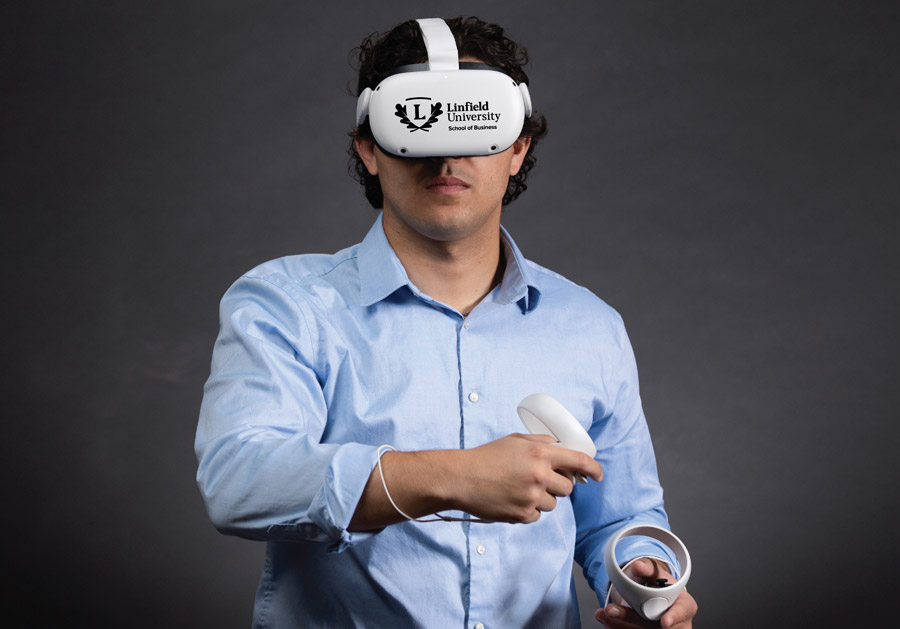
Nursing isn’t Linfield’s only foray into VR — the School of Business currently has 15 headsets, which are used by graduate students in the design and innovation track of the Master of Science in business program.
“We’re familiarizing our students and faculty with the technology and trying to figure out ways we can use those virtual environments for our non-traditional learners as well as our more traditional Linfield students,” said Jennifer Madden, business school dean. “Graduate students recently helped the Board of Trustees become familiar with the goggles, and we had them out for attendees to try out at the YET! Business Symposium in April.”
Madden’s enthusiasm for VR is shared by President Miles K. Davis.
“There are so many exciting educational possibilities with virtual reality, and the School of Nursing is an excellent starting point,” Davis said.
In May, he said, an anonymous $27,000 donation was given for the university as a whole to explore what other fields of study may benefit from VR.
“We know students learn best through experience, which is why that type of learning is the core of a Linfield education,” he said, adding that comfort and fluency with these technologies as they evolve is a major advantage for students.
“We don’t prepare students for the world as it is — we’re preparing them for the world as it will be.”
—President Miles K. Davis
For his part, Smith hopes this is just the beginning.
“Think about being in an acute-care class and learning about cardiac dysrhythmia, and the professor says, ‘OK, let’s walk through each chamber of the heart and see what’s happening,’” he said. “I’m thrilled that our MEPN students get to try these tools, and I can’t wait to see what comes next.”


