A behind-the-scenes look at crafting Linfield Magazine’s first AI-generated cover
The theme of this magazine’s cover package is “higher education’s high-tech future,” exploring how new technologies are enhancing the way we teach and learn. It may not come as a surprise, then, that we decided to use artificial intelligence (AI) to design the cover itself. How that design process worked – or did not – becomes an aspect of the information we are conveying with the package of stories.
The up-front guidelines: The cover should unmistakably represent Linfield and, simultaneously, portray the ways technology is shaping the future of higher education. It should be completely AI-generated, needing no editing.
What we learned along the way, as is the case with many generative AI processes, is that the inputs and guidelines we used were as critical as the technology in achieving the desired result. We failed to get what we were looking for on the first, second or tenth attempts, requiring a fair bit of tweaking and re-wording the prompts to get the desired output.
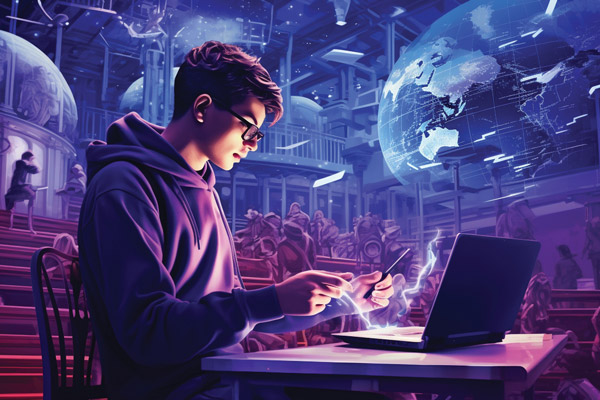
The process:
- Research and inspiration: While past magazine covers served as a foundation, the goal was to craft something distinct – a design that would stand out in Linfield Magazine’s archives. Meetings with the magazine’s editorial team helped refine the vision of where to start.
- Choosing the right tool: I explored and tried out multiple generative AI tools, each able to turn natural language text commands into images. I first experimented with OpenAI’s Dall-E and the AI tools in Adobe Photoshop. Ultimately, I settled on a program called Midjourney – a tool that integrates a chat app called Discord for entering text prompts. I was already familiar with Discord’s platform, and Midjourney offered the flexibility and precision needed for a project of this scope.
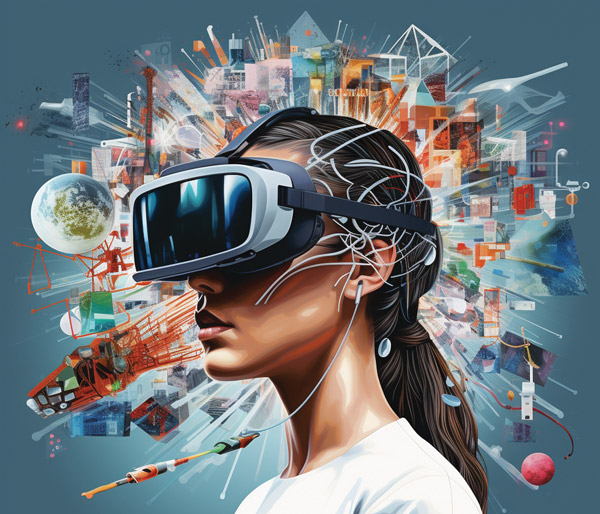
- Crafting the prompts: The initial approach was (probably overly) ambitious. I attempted to encapsulate multiple magazine stories into one design. An early prompt read: “A stylized representation of a nurse wearing virtual reality glasses … Symbols of diverse faiths … A roller skate and a nurse’s cap …” The result? A chaotic image that lacked any central clarity.
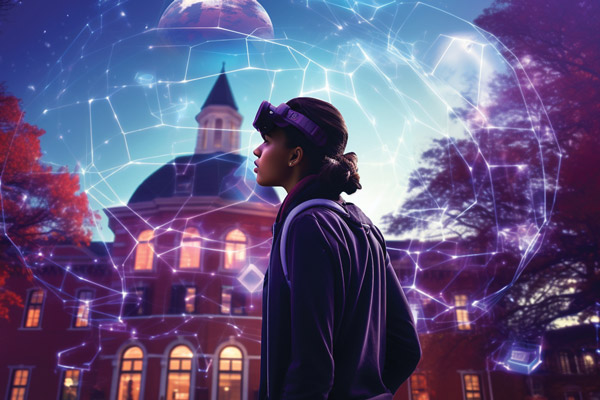
As the iterations progressed, introducing elements like “visualization of artificial intelligence and neural networks” began to yield fascinating results. Futuristic abstractions started to dominate the canvas, setting the tone we all agreed we liked. - Refining the prompts: I adjusted the prompts repeatedly, and when the images looked sufficiently new, I ran them by the magazine team. They provided feedback, we debated the images alongside the stories in the cover package, and I refined it again. In the end, the journey from initial concept to final design was marked by close to 100 iterations. My original concept was to blend multiple stories into a single image; however, the focus gradually shifted to a thematic emphasis on the idea that technology will change higher education.
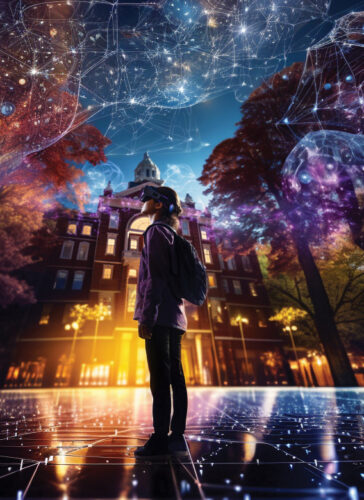
The result was a design featuring an evocative (and Linfield-inspired) image: A student donning VR goggles gazing toward a promising future. Pioneer Hall, reimagined through an AI lens, stands proudly in the background. A vast neural network sprawls across the top symbolizing interconnectedness and innovation. And the university observatory, traditionally a beacon of exploration, is on the back seemingly “observing the future.”
The final product is a testament to Linfield’s forward-thinking ethos and belief in the transformative power of technology. But this project also underscored a vital lesson: While AI offers limitless possibilities, using it to realize a specific vision demands patience and meticulous refinement.


