
The legacy of two Linfield women who played important roles in Title IX’s passing and adoption

Fifty years ago, President Richard Nixon signed into law the Educational Amendments of 1972. Title IX of the amendments, composed of only 37 words, required equal treatment of men and women in higher education at any institution receiving federal funding in the form of grants, scholarships and other aid.
It reads:
No person in the United States shall, on the basis of sex, be excluded from participation in, be denied the benefits of, or be subjected to discrimination under any education program or activity receiving federal financial assistance.”
—Title IX of the Educational Amendments of 1972
Three years after its passage, on Dec. 16, 1975, a small group representing Linfield College met with Rep. Edith Green at the University Club in Portland. The agenda revolved around a single topic – how could Linfield better meet the intent of Title IX. Joining President Charles Walker were academic administrators, as well as athletic directors Jane McIlroy and Ad Rutschman. The group debated the funding challenges and methods of implementing Title IX.


An irony (for Linfield) of that historic gathering is that Walker’s and Rutschman’s achievements are justifiably engrained in the university’s collective memory, while Green’s and McIlroy’s have largely been forgotten in the decades since. This despite the fact that the two women were pioneers for women in education nationwide and left as much of an indelible impact on the Linfield experience as their male colleagues.
Green, who joined the Linfield Board of Trustees in 1970, eventually served 10 terms in the U.S. House of Representatives, authored Title IX and shepherded it to adoption. A longtime advocate for the equal treatment of women, she championed predecessors to Title IX such as the National Defense of Education Act of 1958 and Equal Pay Act of 1963.
“You had equal rights, but you couldn’t do anything with those rights,” Green said in an oral history interview archived at the Lyndon B. Johnson Presidential Library. “But when it was possible for a woman who wanted to go to college … to borrow money or to get a grant or to have work-study and get that degree that would open those doors.”
McIlroy, a Linfield professor and athletic director for 32 years, began transforming the landscape of athletics curricula and sports opportunities for Wildcat women decades before Title IX. In addition to championing changes in the classroom and on fields and courts, McIlroy was recognized as the first woman in the country to govern a college athletic program at the 1982 national convention of the Association of Intercollegiate Athletics for Women.
“She had fought and been a pioneer in terms of her right to participate in physical activities, and she dedicated her life to making sure other women had more opportunities,” said Robin Vealey, one of McIlroy’s colleagues at Linfield from 1977-80.
True, there have been many throughout Linfield history who worked hard to create gender-equal opportunities – the first and, so far, only female president, Vivian Bull; Merle Templeton ’74, the first male student admitted into the Good Samaritan School of Nursing; and Jane Claire Dirks-Edmunds ’37, Linfield’s first female Ph.D. faculty member; among others. Yet, the impact of McIlroy and Green’s accomplishments still reverberate not just at Linfield – but more broadly across American culture – as the country celebrates the 50th anniversary of Title IX.
Rebel with a cause
McIlroy joined Linfield in 1950 as a veteran of World War II’s Women’s Army Corps and having already completed a master’s degree in health and physical education at the University of Oregon. During the following decade, she earned a doctorate in the same field from Indiana University.
Lynn Jenssen, McIlroy’s care provider late in life until her death in 2016, said McIlroy “felt if she had something that could help someone else, then it was her duty or responsibility to help them.”
After McIlroy’s mother died when she was 3 years old, her father, Col. James G. McIlroy, advised young Jane to bottle up any emotions she felt in the aftermath of the loss. She found an outlet in physical pursuits and occasional fisticuffs.
In her father’s memoir of his years as a military attaché, he described his daughter as “very strong, a fine physical specimen.” One passage detailed her slugging the son of a Mexican ambassador who was preventing her from doing classwork. Despite her father’s admonishment to “handle boys in a less crude manner,” the two tussled again when the boy taunted McIlroy and stomped on an American flag. She responded by punching him in the chest. After a talk with the school principal, he gifted the laundered flag to McIlroy, which she hung over her bed.
McIlroy eventually found her passion in sports.
When she arrived at Linfield, women’s opportunities in the classroom and on fields and courts were limited. When women were given the spotlight, it was as part of events like “Play Days” and “Sports Days.”
After [President Harry Dillin] hired me, I asked, ‘Where are the teams?’ He said I was being hired to get the program going. So that’s what I did.”
—Dr. Jane McIlroy
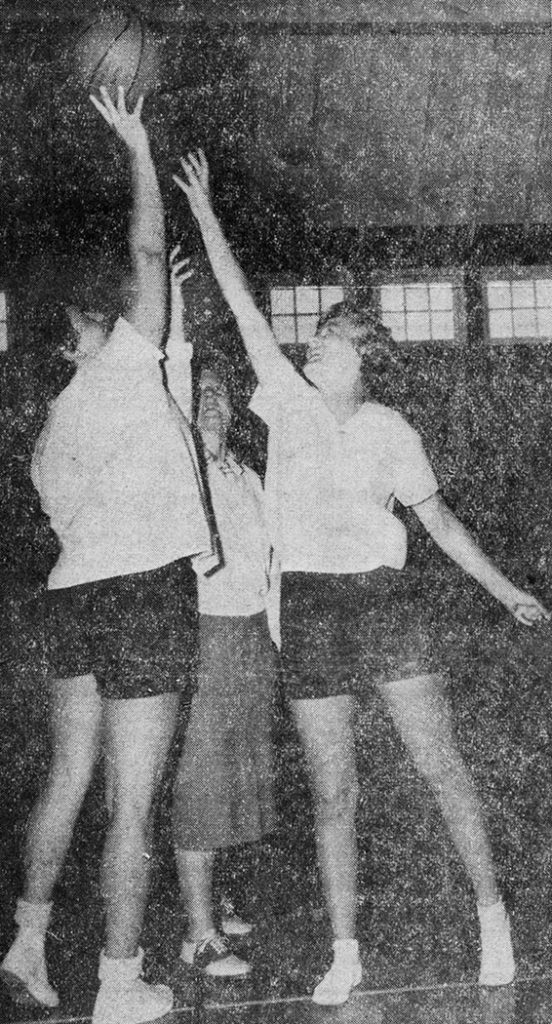
In addition to teaching, McIlroy took on advising or coaching roles to the women’s field hockey, basketball, softball, track and field, bowling and cross country teams. McIlroy also worked with coaches at other schools to develop the Women’s Conference of Independent Colleges (WCIC).
Resistance to incorporating women’s athletics into the budget was strong in that era, especially when it came to funding them at the expense of men’s sports. When teams traveled, McIlroy remembered collecting a quarter from each student-athlete for gas.
“If they didn’t, there was no way I could afford to transport them,” McIlroy told Linfield Magazine. “I bought a station wagon that carried six in the seating area and had a big space for the equipment.”
McIlroy had a direct hand in Title IX’s implementation after its passage. By advocating for basketball and volleyball to receive preferential funding as the “big sports,” McIlroy hoped to generate revenue for other developing programs.
In a letter from McIlroy to Green following the 1975 University Club meeting, McIlroy described a budget of $49,000 for the men’s athletic programs compared to one of $6,600 for the women’s teams. She was concerned with the limitations of trying to fund two extensive athletic departments.
“I desire activity opportunity for all skill levels, and unfortunately the trend has been to put most of our marbles in the bag of the highly skilled,” she wrote. “[I] am hoping that the pressures resulting will bring about a reassessment of men’s as well as women’s athletics on a nationwide basis.”
McIlroy, though, had strong reservations about the male-led NCAA stepping in to manage women’s sports.
“She could see that women would lose opportunities in coaching and teaching, and that was pretty much what happened,” Vealey said. “She had worked carefully when setting up the WCIC to have women coaches and women leading the organization. Some people attributed her resistance [to the NCAA] to her age and progress passing her by. It was only that she could see where the changes would lead.”
In 1981, McIlroy was named one of six “Oregon Pioneer Ladies” by the Giusti Club of Champions. She retired from Linfield the following year and was inducted into the Linfield Hall of Fame in 2000. Her name and spirit live on in the McIlroy-Lewis Sports Award given yearly to the most competitive institution in the Northwest Conference. While advancements in women’s athletics were the most outwardly visible contributions, McIlroy was most passionate about the changes she fostered for female students in classrooms.
“I’m in favor of women having opportunities in competitive sports, but sports should not be number one,” McIlroy said. “Academics should be number one. That’s the way I’ve always felt.”
Mrs. Green goes to Washington
Four years into McIlroy’s tenure at Linfield, Green, a teacher and parent-teacher association member, beat future governor Tom McCall in a bid to represent Oregon in the U.S. House of Representatives.
Breaking down gender stereotypes, prejudices and expectations were already in Green’s sights when she went to Washington, D.C. Social norms hemmed her in long before she mounted a political career.
“It’s pretty clear she wanted to do something more than teaching, but it is where she spent most of her non-political career,” said Christopher Foss, an author and adjunct professor of history at Washington State University. Green’s life and work are the subject of a book he is writing. “Green was involved in speech and debate teams throughout high school and wanted to be a lawyer, but she seems to have been dissuaded from it by her parents.”
If McIlroy was the reserved doer, Green was the standard-bearer lighting the way forward to a nation of women who knew they deserved more opportunity than they were being offered.
After a stint in Portland radio, a teacher shortage drew her back into the classroom. Then Green’s role as a mother of two boys led to membership in, and eventually leadership of, a local Parent Teacher Association chapter. Green grew into a powerful voice in statewide education movements and education-related legislation. She lost an initial campaign to be Oregon’s secretary of state in 1952, but after beating McCall in 1954, she never lost another election.
Within a year of being elected, Green introduced legislation that would equalize pay for women but was stonewalled when she tried to schedule a hearing.
“They had lots of hearings on discrimination on the basis of race but none on the basis of sex,” Green said.
If Congress wasn’t ready for equal pay, the race to space was something it could get behind. And it laid the foundation for Green to push for equity in education. In October 1957, Sputnik became the first man-made satellite to reach orbit, and it was the Soviet space program that launched it.
“Sputnik did more for education … than a lot of other people could possibly do because they awakened the American people to the challenge that was facing them,” Green said. Building a reservoir of mathematicians, engineers and scientists that could develop an American-made spacecraft, send it to the moon and safely return it to Earth rocketed to the top of governmental, and cultural, priorities.
Ten months after Sputnik’s launch, Green helped secure the passage of the National Defense of Education Act, which poured money into higher education with the goal of beating the Soviets in the space race. It also established the National Defense Student Loan program that provided low-interest federal loans to low-income students pursuing degrees. During the next eight years, Congress expanded the types of loans available to students, but to Green’s disappointment, the programs frequently benefitted males more than females.
From her earliest days in the House of Representatives, Green was an ally of future President John F. Kennedy, dating back to his initial bid as a vice presidential candidate in 1956. Her persistence paid off, and Kennedy signed the Equal Pay Act in 1963.
For her advocacy in Oregon and the nation, Linfield presented Green with an honorary doctorate in 1964.
By the late 1960s, Green was seen as one of the more moderate Democrats in Congress. Protests, and occasionally violence, roiled American college and university campuses as opposition to the Vietnam War grew.
“For a while, Green was close with a contingent of the Congress that wanted to claw back funding they had approved in the years before as punishment” for the Vietnam conflict, Foss said. “What’s even more shocking is that there was a period she wanted to sink the entire package of the Educational Amendments of 1972, which contained Title IX. She voted against it when it was at the committee level and only supported it when it went to the floor of the House of Representatives.”
Title IX of the Education Amendments of 1972, authored by Green, ultimately changed the landscape for women.
“For years – and I think my record shows it – I participated in the great national struggle against discrimination, both on the basis of race and on the basis of sex,” she said in a 1974 lecture at the University of Michigan. “I do suggest that there have been many talents undiscovered and many skills wasted. And I do suggest that the future of this country, which is dependent upon the will and the wisdom of its citizens, is damaged –irreparably damaged – when any individuals… are treated as unequal citizens.”
When Green left Congress in 1975, she didn’t stay in Washington, D.C. as many of her peers chose to do.
“She was faithful to Oregon, she joined the Board of Trustees at Linfield, she was a board member of Benj. Franklin Savings and Loan, and she was on the State Board of Higher Education,” Foss said. “She stayed active and involved in those issues that she was passionate about: education, the welfare of children and opportunities for women.”
No fences
Though she was a longtime advocate for equal opportunities, Green knew the passage of Title IX and other legislation was only a starting point. That there would still be much work to do.
“I do not think that we are going to reach the ideal overnight; it is going to take a long time,” she said.
“One place to begin is the schools … there are so many things that need to be done, but I suggest that we start out by providing equal educational opportunities and by making girls realize when they are very young that they can have the same aspirations and try to attain the same goals as their brothers, or as other boys in their classes.”
—Edith Green
As Green predicted, implementation of this 37-word phrase has – and continues to take – a long time to get right, and debates about its application still rise to Congress and the courts. But the dream of women’s rights and Title IX pioneers still exists. The distance traversed between 1972 and now is, perhaps, best illustrated in one of McIlroy’s scrapbooks.
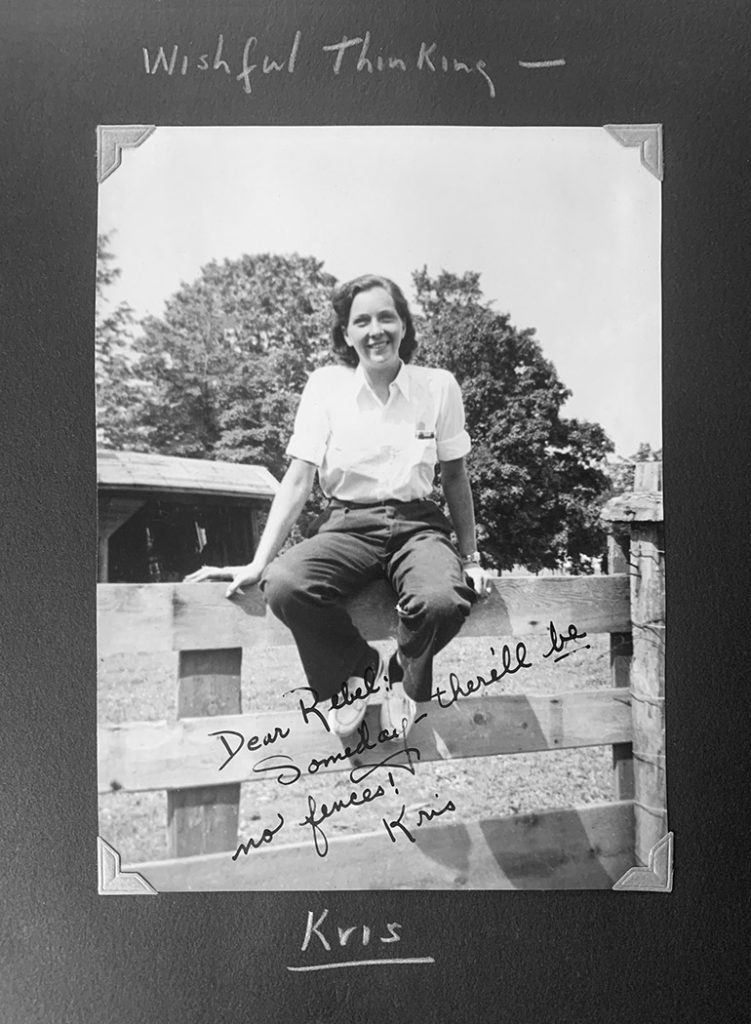
Mounted inside is a picture of Barbara “Kris” Olsen, a longtime McIlroy friend with whom she scaled mountains and went sailing. It was probably taken in the late 1950s or early 1960s. A garage is visible in the background across a medium-sized yard, large trees beyond that. Olsen smiles wide in the foreground dressed in a button-up shirt, pants and loafers while sitting on a fence.
There’s an inscription across the bottom that reads: “Dear Rebel, Someday there’ll be no fences! Kris.”
Above the photo, McIlroy wrote: “Wishful thinking.”
Editor’s note
In preparing this story, writer Eric Howald rifled through boxes of materials at the Oregon Historical Society and spoke to people who knew both women. Unfortunately, even with Rep. Edith Green’s connection to our institution, the information about her impact on Linfield was limited.
As we neared the final weeks of production on this edition, I visited the Linfield Archives to do final fact-checking. I was toward the end of a row, pulling boxes related to President Hellie’s inauguration in 2007. As I loaded up a cart with the boxes, I saw to my right a shelf of boxes labeled simply “Presidential – Misc.” Curious, I chose a box off the shelf at random and started rifling through the files. While much of Linfield’s history has been carefully indexed and organized, I soon realized that this shelf held the materials that awaited cataloging. As I scanned through file folders, a handwritten tab caught my eye with the words “Edith Green.”
In it was correspondence from Green to Presidents Bjork and Walker. There were memos from her time on the Linfield College Board of Trustees and a copy of a note she sent Linda Olds as the first recipient of her endowed professorship. I found the transcript from a 1974 speech at the University of Michigan and the 1979 program from when she was named Portland’s First Citizen. Most importantly for this story, I found a letter from Jane McIlroy to Green about Title IX at Linfield. Bits of the information were ultimately woven into this story, and no doubt future writers and historians will make even more use of this fortuitous find.
—Kathy Foss, editor


